
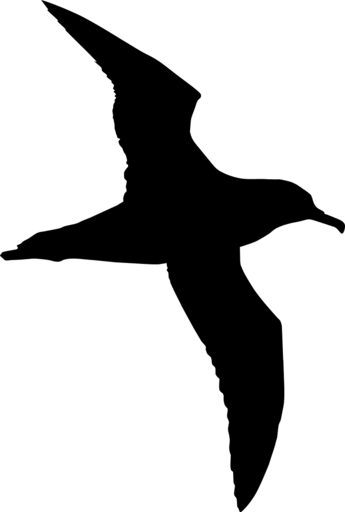
Little Shearwater
Puffinus assimilis
Silhouette: Juan Carlos Jerí · PhyloPic
- KingdomAnimalia (Animals)
- PhylumChordata (Chordates)
- ClassAves (Birds)
- OrderProcellariiformes (Tubenoses)
- FamilyProcellariidae (Shearwaters and Petrels)
- GenusPuffinus (Small Shearwaters)
- SpeciesPuffinus assimilis (Little Shearwater)
About the Little Shearwater
The little shearwater (Puffinus assimilis) is a small shearwater in the petrel family Procellariidae. Despite the generic name, it is unrelated to the puffins, which are auks, the only similarity being that they are both burrow-nesting seabirds.
This shearwater has the typically "shearing" flight of the genus, dipping from side to side on stiff wings with few beats, the wingtips almost touching the water, though in light winds it has a more flapping flight than that of its larger relatives. In flight it looks cross-shaped, with its wings held at right angles to the body, its colouration changing from black to white as the black upperparts and white underparts are alternately exposed as it travels low over the sea.
At 25–30 cm (9.8–11.8 in) in length with a 58–67 cm (23–26 in) wingspan, it is like a small Manx shearwater but has proportionally shorter and broader wings, with a pale area on the inner flight feathers. Its bill is more slender than that of Manx, and its dark eye stands out against the surrounding white area.
mtDNA cytochrome b sequence data indicate that the former North Atlantic little shearwater group (Boyd's shearwater, P. boydi and... Wikipedia →
Recent sightings of Little Shearwater in Abel Tasman National Park
LIVEiNaturalistClosest Relatives at Abel Tasman National Park

 Fluttering Shearwater
Puffinus gavia

Hutton's Shearwater
Puffinus huttoni

Sooty Shearwater
Puffinus griseus

 Cape Petrel
Daption capense

 Northern Giant Petrel
Macronectes halli

 Westland Petrel
Procellaria westlandica

Southern Giant Petrel
Macronectes giganteus

 Fairy Prion
Pachyptila turtur

 Shy Mollymawk
Thalassarche cauta

 Buller's Mollymawk
Thalassarche bulleri
Global Distribution
Warmer areas are where this animal is recorded most often.
Parks Where Found
| # | Park | Country | Daily sighting probability |
|---|---|---|---|
| 1 | Abel Tasman National Park | 🇳🇿 New Zealand | |
| 2 | Table Mountain National Park | 🇿🇦 South Africa |