
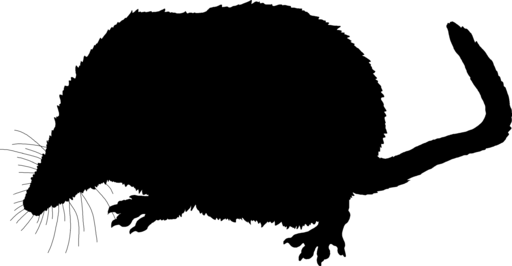
American Pygmy Shrew
Sorex hoyi
Silhouette: Becky Barnes · PhyloPic
- KingdomAnimalia (Animals)
- PhylumChordata (Chordates)
- ClassMammalia (Mammals)
- OrderSoricomorpha
- FamilySoricidae (Shrews)
- GenusSorex (Long-tailed Shrews)
- SpeciesSorex hoyi (American Pygmy Shrew)
About the American Pygmy Shrew
The American pygmy shrew (Sorex hoyi), also called the eastern pygmy shrew, is a small shrew found throughout much of Alaska, Canada, and the northern contiguous United States, as well as south along the Appalachian Mountains and in a small region in the Colorado and Wyoming Rockies. The species was first discovered in 1831 by naturalist William Cane in Georgian Bay, Parry Sound.
This animal is found in northern coniferous and deciduous forests of North America. It is believed to be the second-smallest mammal in the world, but has an extremely large appetite for its size. Due to its fast metabolism, it needs to eat constantly. It digs through moist soils and decaying leaf litter for food.
The American pygmy shrew is the smallest mammal native to North America and is one of the smallest mammals in the world, just slightly larger than the Etruscan shrew of Eurasia. Its body is about 5 cm (2 in) long including a 2-cm-long tail, and it weighs about 2.0 to 4.5 g (0.07 to 0.16 oz). Its pelage is generally a reddish or grayish brown during the summer, and a white-gray color during the winter. The underside is generally a lighter gray. This animal molts about twice a year... Wikipedia →
Recent sightings of American Pygmy Shrew in Acadia National Park
LIVEiNaturalistClosest Relatives at Acadia National Park


Global Distribution
Warmer areas are where this animal is recorded most often.
Parks Where Found
| # | Park | Country | Daily sighting probability |
|---|---|---|---|
| 1 | Acadia National Park | 🇺🇸 United States |
More parks will be added in future updates.