


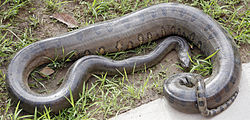


Anaconda
Eunectes murinus
Silhouette: Gamma 124 · PhyloPic
- KingdomAnimalia (Animals)
- PhylumChordata (Chordates)
- ClassSquamata
- FamilyBoidae (Boas)
- GenusEunectes (Anacondas)
- SpeciesEunectes murinus (Anaconda)
About the Anaconda
The green anaconda (Eunectes murinus), common anaconda, common water boa, akayima, or sucuri, is a boa species found in South America. It is one of the longest and heaviest known extant snake species. Like all boas, it is a non-venomous constrictor. Green anacondas generally have a life expectancy of 10 years in the wild, although some specimens live longer when they are taken care of in captivity. Green anacondas live in tropical rainforests and tend to prefer shallow, slow-moving waters, such as streams, rivers and flooded grasslands. They spend most of their time in the water but are also found on land in thick vegetation.
In the famous 10th edition of Systema Naturae of 1758, Carl Linnaeus cited descriptions by Albertus Seba and by Laurens Theodorus Gronovius to erect the distinct species murina of his new genus Boa, which contained eight other species, including Boa constrictor. The generic name Boa came from an ancient Latin word for a type of large snake. The first specimens of Boa murina were of immature individuals from 75 to 90 cm (2.5 to 3.0 ft) in length. In 1830, Johann Georg Wagler erected the separate genus Eunectes for Linnaeus's Boa murina after more... Wikipedia →
Recent sightings of Anaconda in Amacayacu National Natural Park
LIVEiNaturalistClosest Relatives at Amacayacu National Natural Park


Global Distribution
Warmer areas are where this animal is recorded most often.
Parks Where Found
| # | Park | Country | Daily sighting probability |
|---|---|---|---|
| 1 | Cuyabeno Wildlife Reserve | 🇪🇨 Ecuador | |
| 2 | Yasuní National Park | 🇪🇨 Ecuador | |
| 3 | Amacayacu National Natural Park | 🇨🇴 Colombia | |
| 4 | Tambopata National Reserve | 🇵🇪 Peru | |
| 5 | Sierra de la Macarena National Park | 🇨🇴 Colombia | |
| 6 | Emas National Park | 🇧🇷 Brazil | |
| 7 | Anavilhanas National Park | 🇧🇷 Brazil | |
| 8 | Cordillera Azul National Park | 🇵🇪 Peru | |
| 9 | Manu National Park | 🇵🇪 Peru |
Quick answers
What are the chances of seeing a Anaconda in Amacayacu National Natural Park?
About 10% of wildlife watchers report a Anaconda sighting in Amacayacu National Natural Park, based on 6 verified sightings from GBIF citizen-science data.
When is the best time to see Anaconda in Amacayacu National Natural Park?
December has the highest sighting rate for Anaconda in Amacayacu National Natural Park in our monthly data.