
Silhouette: Sheatherius · PhyloPic
Nocturnal Curassow
Nothocrax urumutum
- KingdomAnimalia (Animals)
- PhylumChordata (Chordates)
- ClassAves (Birds)
- OrderGalliformes (Landfowl)
- FamilyCracidae (Guans, Chachalacas, and Curassows)
- GenusNothocrax
- SpeciesNothocrax urumutum (Nocturnal Curassow)
About the Nocturnal Curassow
The nocturnal curassow (Nothocrax urumutum) is a species of bird in the family Cracidae, the chachalacas, guans, and curassows. It is found in Brazil, Colombia, Ecuador, Peru, and Venezuela. The nocturnal curassow was originally placed in genus Crax but genetic data confirm that Nothocrax is a valid genus. It is the only member of its genus and has no subspecies.
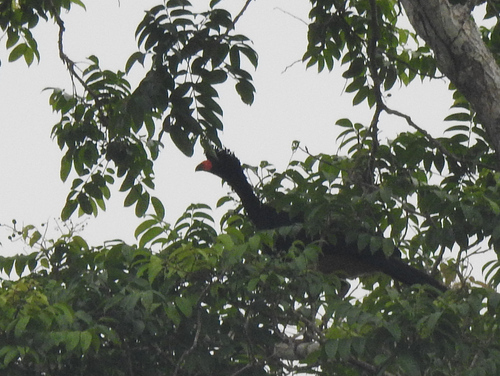
The nocturnal curassow is the smallest curassow at 50 to 57.5 cm (1.6 to 1.9 ft) long. One bird weighed 1,250 g (2.8 lb). It is also unique with its mostly rufous and chestnut plumage, as other curassows are mostly black. Its crest is flat and blackish, its ventral area buffy, and the tips of its tail feathers are paler than the rest. Its brownish-orange eye is surrounded by bare skin, greenish-yellow above and black below. The bill is reddish-orange and the legs gray.
The nocturnal curassow is found in middle and upper Amazonia, from far southern Venezuela, southeastern Colombia, eastern Ecuador, and northeastern Peru into western and central Brazil. It inhabits terra firme forest and flooded forests (both permanent and seasonal). It favors low... Wikipedia →
Recent sightings of Nocturnal Curassow in Amacayacu National Natural Park
LIVEiNaturalistClosest Relatives at Amacayacu National Natural Park

 Speckled Chachalaca
Ortalis guttata

 Spix's Guan
Penelope jacquacu

Blue-throated Piping-Guan
Pipile cumanensis
Wattled Curassow
Crax globulosa

Razor-billed Curassow
Mitu tuberosum

Salvin's Curassow
Mitu salvini

 Wild Turkey
Meleagris gallopavo

Marbled Wood Quail
Odontophorus gujanensis
Global Distribution
Warmer areas are where this animal is recorded most often.
Parks Where Found
| # | Park | Country | Daily sighting probability |
|---|---|---|---|
| 1 | Amacayacu National Natural Park | 🇨🇴 Colombia | |
| 2 | Yasuní National Park | 🇪🇨 Ecuador | |
| 3 | Cuyabeno Wildlife Reserve | 🇪🇨 Ecuador | |
| 4 | Anavilhanas National Park | 🇧🇷 Brazil |
Quick answers
What are the chances of seeing a Nocturnal Curassow in Amacayacu National Natural Park?
Under 5% of wildlife watchers report a Nocturnal Curassow sighting in Amacayacu National Natural Park, based on 41 verified sightings from GBIF citizen-science data.
When is the best time to see Nocturnal Curassow in Amacayacu National Natural Park?
January has the highest sighting rate for Nocturnal Curassow in Amacayacu National Natural Park in our monthly data.