
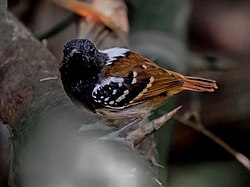


Chestnut-tailed Antbird
Myrmeciza hemimelaena
Silhouette: Sheatherius · PhyloPic
- KingdomAnimalia (Animals)
- PhylumChordata (Chordates)
- ClassAves (Birds)
- OrderPasseriformes (Perching Birds)
- FamilyThamnophilidae (Typical Antbirds)
- GenusMyrmeciza
- SpeciesMyrmeciza hemimelaena (Chestnut-tailed Antbird)
About the Chestnut-tailed Antbird
The southern chestnut-tailed antbird, or chestnut-tailed antbird, (Sciaphylax hemimelaena) is a species of passerine bird in subfamily Thamnophilinae of family Thamnophilidae, the "typical antbirds". It is found in Bolivia, Brazil, and Peru.
The southern chestnut-tailed antbird has a complicated taxonomic history. It was originally described by the English zoologist Philip Sclater in 1857 and given the binomial name Myrmeciza emimelaena. It later acquired the English name "chestnut-tailed antbird" and its current specific epithet hemimelaena. By the early twentieth century it had two recognized subspecies. In 1932 a third subspecies, M. h. castanea, was described. That subspecies was much later recognized as the separate species M. castanea. Some taxonomic systems call it the "northern chestnut-tailed antbird" and the reduced M. hemimelaena the "southern chestnut-tailed antbird". Other systems retained "chestnut-tailed antbird" for M. hemimelaena and called the newly-separated M. castanea "Zimmer's antbird".
A molecular phylogenetic study published in 2013 found that genus Myrmeciza, as then defined, was polyphyletic. In the resulting rearrangement to... Wikipedia →
Recent sightings of Chestnut-tailed Antbird in Amboró National Park
LIVEiNaturalistClosest Relatives at Amboró National Park

 Black-throated Antbird
Myrmeciza atrothorax

Variable Antshrike
Thamnophilus caerulescens

Giant Antshrike
Batara cinerea

Rufous-capped Antshrike
Thamnophilus ruficapillus

Plain-winged Antshrike
Thamnophilus schistaceus

Black-capped Antwren
Herpsilochmus atricapillus

Plain Antvireo
Dysithamnus mentalis

Great Antshrike
Taraba major

Bolivian Slaty-Antshrike
Thamnophilus sticturus

East Amazonian Fire-eye
Pyriglena leuconota

Pygmy Antwren
Myrmotherula brachyura

Gray Antwren
Myrmotherula menetriesii
Global Distribution
Warmer areas are where this animal is recorded most often.
Parks Where Found
| # | Park | Country | Daily sighting probability |
|---|---|---|---|
| 1 | Madidi National Park | 🇧🇴 Bolivia | |
| 2 | Tambopata National Reserve | 🇵🇪 Peru | |
| 3 | Manu National Park | 🇵🇪 Peru | |
| 4 | Amboró National Park | 🇧🇴 Bolivia | |
| 5 | Cordillera Azul National Park | 🇵🇪 Peru | |
| 6 | Noel Kempff Mercado National Park | 🇧🇴 Bolivia | |
| 7 | Parque Estadual Encontro das Águas | 🇧🇷 Brazil |
Quick answers
What are the chances of seeing a Chestnut-tailed Antbird in Amboró National Park?
About 10% of wildlife watchers report a Chestnut-tailed Antbird sighting in Amboró National Park, based on 37 verified sightings from GBIF citizen-science data.
When is the best time to see Chestnut-tailed Antbird in Amboró National Park?
November has the highest sighting rate for Chestnut-tailed Antbird in Amboró National Park in our monthly data.