



Military Macaw
Ara militaris
Silhouette: Myriam_Ramirez · PhyloPic
- KingdomAnimalia (Animals)
- PhylumChordata (Chordates)
- ClassAves (Birds)
- OrderPsittaciformes (Parrots)
- FamilyPsittacidae (New World and African Parrots)
- GenusAra
- SpeciesAra militaris (Military Macaw)
About the Military Macaw
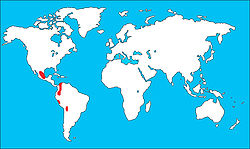
The military macaw (Ara militaris) is a medium to large-sized macaw, named after its green and red plumage vaguely resembling a military uniform. It is native from west-central Mexico south through northern Argentina and Bolivia. While most wild populations are currently listed by the IUCN as vulnerable - and listed as endangered by Mexico - the species is still seen commonly in zoos and parks worldwide. The military macaw may be bred in captivity with relative ease, and is usually available through the pet trade. It is among the longest-lived one can own, requiring advanced knowledge, experience and confidence to keep them healthy, stimulated and thriving.
The military macaw was formally described in 1766 by Swedish naturalist Carl Linnaeus in the 12 edition of his Systema Naturae, where he placed it within the genus Psittacus, coining the binomial name Psittacus militaris. Linnaeus did not specify a type locality, but it was designated as 'Colombia' in 1912. The military macaw is, now, one of ten species in the genus Ara, designated in 1799 by French naturalist Bernard Germain de Lacépède. The name Ara comes directly from the Tupi word ará ("macaw"), of the native Brazilian... Wikipedia →
Recent sightings of Military Macaw in Amboró National Park
LIVEiNaturalistClosest Relatives at Amboró National Park

 Chestnut-fronted Macaw
Ara severus

Red-fronted Macaw
Ara rubrogenys

 Blue-and-yellow Macaw
Ara ararauna

Red-and-green Macaw
Ara chloropterus

 blue-crowned conure
Aratinga acuticaudata

 Yellow-chevroned Parakeet
Brotogeris chiriri

Mitred Parakeet
Aratinga mitrata

 Blue-fronted Parrot
Amazona aestiva

White-eyed Parakeet
Aratinga leucophthalma

 Green-cheeked Parakeet
Pyrrhura molinae

Blue-headed Parrot
Pionus menstruus

Blue-winged Parrotlet
Forpus xanthopterygius
Global Distribution
Warmer areas are where this animal is recorded most often.
Parks Where Found
| # | Park | Country | Daily sighting probability |
|---|---|---|---|
| 1 | Tayrona National Natural Park | 🇨🇴 Colombia | |
| 2 | Madidi National Park | 🇧🇴 Bolivia | |
| 3 | Sierra de la Macarena National Park | 🇨🇴 Colombia | |
| 4 | Amboró National Park | 🇧🇴 Bolivia | |
| 5 | Manu National Park | 🇵🇪 Peru | |
| 6 | Henri Pittier National Park | 🇻🇪 Venezuela | |
| 7 | Cordillera Azul National Park | 🇵🇪 Peru | |
| 8 | Utría National Natural Park | 🇨🇴 Colombia |
Quick answers
What are the chances of seeing a Military Macaw in Amboró National Park?
Under 5% of wildlife watchers report a Military Macaw sighting in Amboró National Park, based on 12 verified sightings from GBIF citizen-science data.
When is the best time to see Military Macaw in Amboró National Park?
June has the highest sighting rate for Military Macaw in Amboró National Park in our monthly data.