

Two-colored Mussurana
Mussurana bicolor
Silhouette: Alex Slavenko · PhyloPic
- KingdomAnimalia (Animals)
- PhylumChordata (Chordates)
- ClassSquamata
- FamilyColubridae (Colubrid Snakes)
- GenusMussurana
- SpeciesMussurana bicolor (Two-colored Mussurana)
About the Two-colored Mussurana
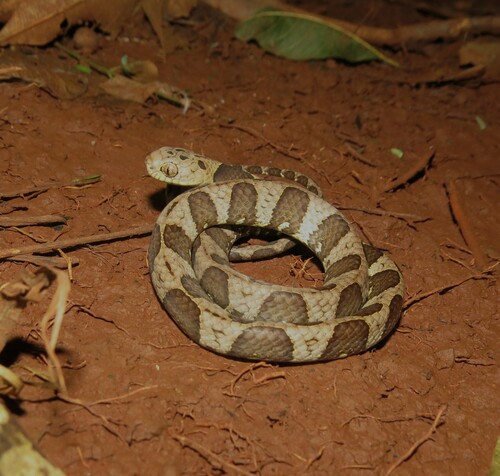
Mussurana bicolor, the two-colored mussurana, is a species of snake in the family Colubridae. The species is native to southern South America. M. bicolor may attain a maximum total length (including tail) of 99 cm (39 in). Adults are gray or brown dorsally, and ivory ventrally. Juveniles are brick red dorsally, with a black vertebral stripe.
M. bicolor is found in Argentina, southern Brazil, Paraguay, and Peru. The preferred natural habitats are grassland, savanna, and forest. M. bicolor is oviparous. Freiberg M (1982). Snakes of South America. Hong Kong: T.F.H. Publications. 189 pp. ISBN 0-87666-912-7. (Clelia bicolor, p. 92).
Peracca MG (1904). "Nouvelles espèces d'Ophidiens d'Asie et d'Amerique, faisante parte de la collection du Museum d'histoire naturelle de Genève ". Revue suisse de Zoologie 12: 663–668. (Oxyrhopus bicolor, new species, pp. 667–668). (in French).
Peters JA, Orejas-Miranda B (1970). Catalogue of the Neotropical Squamata. Part I. Snakes. (With the collaboration of Roberto Donoso-Barros). United States National Museum Bulletin 297. Washington, District... Wikipedia →
Recent sightings of Two-colored Mussurana in Amboró National Park
LIVEiNaturalistClosest Relatives at Amboró National Park

 Wagler's Snake
Xenodon merremii

Brown Sipo
Chironius fuscus

Mountain Sipo
Chironius monticola

Olive Forest Racer
Dendrophidion dendrophis

Aesculapian False Coral Snake
Erythrolamprus aesculapii

Mountain Keelback
Helicops angulatus

 Blunthead Tree Snake
Imantodes cenchoa

Erythrolamprus dorsocorallinus
Erythrolamprus dorsocorallinus

Central Sipo
Chironius quadricarinatus

False Fer-de-lance
Xenodon rabdocephalus
Neotropical Snail-eater
Dipsas cisticeps
Global Distribution
Warmer areas are where this animal is recorded most often.
Parks Where Found
| # | Park | Country | Daily sighting probability |
|---|---|---|---|
| 1 | Amboró National Park | 🇧🇴 Bolivia |
More parks will be added in future updates.