



Black Caiman
Melanosuchus niger
Silhouette: David Stanley · PhyloPic
- KingdomAnimalia (Animals)
- PhylumChordata (Chordates)
- ClassCrocodylia
- FamilyAlligatoridae (Alligators and Caimans)
- GenusMelanosuchus (Black Caimans)
- SpeciesMelanosuchus niger (Black Caiman)
About the Black Caiman
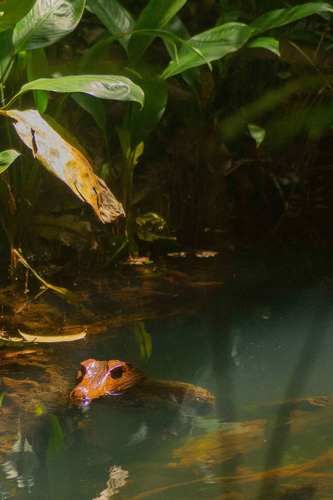
The black caiman (Melanosuchus niger) is a crocodilian reptile endemic to South America. With a maximum length of around 5 to 6.5 m (16 to 21 ft) and a mass of over 450 kg (1,000 lb), it is the largest living species of the family Alligatoridae, and the third-largest crocodilian in the Neotropical realm. True to its common and scientific names, the black caiman has a dark greenish-black coloration as an adult. In some individuals, the pigmentation can appear almost jet-black. It has grey to brown banding on the lower jaw; juveniles have a more vibrant coloration compared to adults, with prominent white-pale yellow banding on the flanks that remains present well into adulthood (more than most other species). The banding on young helps with camouflage by breaking up their body outline, on land or in water, in an effort to avoid predation. The morphology is quite different from other caimans but the bony ridge that occurs in other caimans is present. The head is large and heavy, an advantage in catching larger prey. Like all crocodilians, caimans are long, squat creatures, with big jaws, long tails and short legs. They have thick, scaled skin, and their eyes and noses are located on the tops of their heads. This enables them to see and breathe while the rest of their body is underwater.
A carnivorous animal, the black caiman lives along freshwater habitats, including slow-moving rivers, lakes and seasonally flooded savannas, where it preys upon a variety of fish, reptiles, birds, and mammals. Being an apex predator and potentially a keystone species, it is a generalist, capable of taking most animals within its range, and might have played a critical role in maintaining the structure of the ecosystem. Although only a mere few specific ecological studies have been conducted, it is observed that this species has its own niche which allows coexistence with other competitors.
Reproduction takes place in the dry season. Females build a nest mound with an egg chamber, protecting the eggs from predators. Hatchlings form groups called pods, guarded by the presence of the female. These pods may contain individuals from other nests. Once common, it was hunted to near extinction primarily for its commercially valuable hide. It is now making a comeback, listed as Conservation Dependent. Overall a little-known species, it was not researched in any detail until the 1980s, when the leather-trade had already taken its toll. It is a dangerous species to humans, and attacks have occurred in the past. Wikipedia →
Recent sightings of Black Caiman in Anavilhanas National Park
LIVEiNaturalistClosest Relatives at Anavilhanas National Park




Global Distribution
Warmer areas are where this animal is recorded most often.
Parks Where Found
| # | Park | Country | Daily sighting probability |
|---|---|---|---|
| 1 | Cuyabeno Wildlife Reserve | 🇪🇨 Ecuador | |
| 2 | Anavilhanas National Park | 🇧🇷 Brazil | |
| 3 | Tambopata National Reserve | 🇵🇪 Peru | |
| 4 | Yasuní National Park | 🇪🇨 Ecuador | |
| 5 | Manu National Park | 🇵🇪 Peru | |
| 6 | Noel Kempff Mercado National Park | 🇧🇴 Bolivia | |
| 7 | Amacayacu National Natural Park | 🇨🇴 Colombia | |
| 8 | Madidi National Park | 🇧🇴 Bolivia |
Quick answers
What are the chances of seeing a Black Caiman in Anavilhanas National Park?
About 40% of wildlife watchers report a Black Caiman sighting in Anavilhanas National Park, based on 20 verified sightings from GBIF citizen-science data.
When is the best time to see Black Caiman in Anavilhanas National Park?
October has the highest sighting rate for Black Caiman in Anavilhanas National Park in our monthly data.