

Black Mastiff Bat
Molossus rufus
Silhouette: T. Michael Keesey · PhyloPic
- KingdomAnimalia (Animals)
- PhylumChordata (Chordates)
- ClassMammalia (Mammals)
- OrderChiroptera (Bats)
- FamilyMolossidae (Free-tailed Bats)
- GenusMolossus
- SpeciesMolossus rufus (Black Mastiff Bat)
About the Black Mastiff Bat
The black mastiff bat (Molossus rufus) is a bat species. It ranges from the northern region of South America (excluding Chile), most of Central America (excluding Belize) and parts of southern Mexico. The black mastiff bat was described as a new species in 1805 by French naturalist Étienne Geoffroy Saint-Hilaire. The holotype had been collected in Cayenne, French Guiana.
Males have a forearm length ranging from 48.5–54.0 mm (1.91–2.13 in) and females' forearm lengths are 47–53 mm (1.9–2.1 in). The fur of its back is usually shorter than 3.5 mm (0.14 in). Individuals weight 27–31 g (0.95–1.09 oz). It has a dental formula of 1.1.1.31.1.2.3 for a total of 26 teeth.
The black mastiff bat is a widespread species, occurring throughout much of Central and South America. Its range includes the following countries: Argentina, Belize, Bolivia, Brazil, Colombia, Costa Rica, Ecuador, El Salvador, French Guiana, Guatemala, Guyana, Honduras, Mexico, Nicaragua, Panama, Paraguay, Peru, Trinidad and Tobago, and Uruguay. Its habitat includes forests and shrublands, with human structures used as roosts.
As of 2015, it is evaluated... Wikipedia →
Recent sightings of Black Mastiff Bat in Anavilhanas National Park
LIVEiNaturalistClosest Relatives at Anavilhanas National Park

 greenhall's dog-faced bat
Cynomops greenhalli

Greater Dog-like Bat
Peropteryx kappleri

 Proboscis Bat
Rhynchonycteris naso

Lesser Dog-like Bat
Peropteryx macrotis
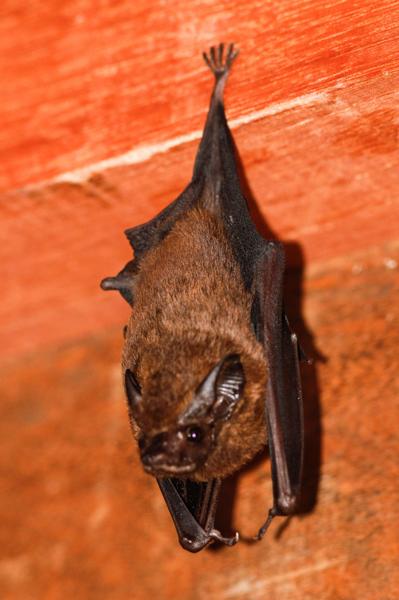
Chestnut Sac-winged Bat
Cormura brevirostris

Lesser Sac-winged Bat
Saccopteryx leptura
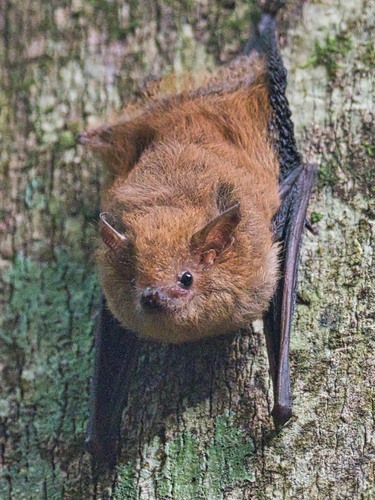
Shaggy Bat
Centronycteris maximiliani

Vampire Bat
Desmodus rotundus

MacConnell's bat
Mesophylla macconnelli

Greater Sac-winged Bat
Saccopteryx bilineata
Global Distribution
Warmer areas are where this animal is recorded most often.
Parks Where Found
| # | Park | Country | Daily sighting probability |
|---|---|---|---|
| 1 | Anavilhanas National Park | 🇧🇷 Brazil |
More parks will be added in future updates.