

Baja California Ratsnake
Bogertophis rosaliae
Silhouette: Alex Slavenko · PhyloPic
- KingdomAnimalia (Animals)
- PhylumChordata (Chordates)
- ClassSquamata
- FamilyColubridae (Colubrid Snakes)
- GenusBogertophis
- SpeciesBogertophis rosaliae (Baja California Ratsnake)
About the Baja California Ratsnake
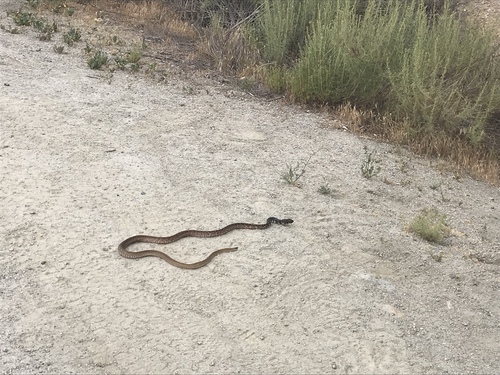
The Baja California rat snake (Bogertophis rosaliae) is a species of nonvenomous snake in the family Colubridae. The species is native to Baja California, Mexico; extreme southern California; and some islands in the Sea of Cortés.
The Baja California rat snake is a large, slender colubrid snake with a long head, large eyes, and smooth dorsal scales. Adults have a total length (including tail) of 85–150 cm (33–59 in). Each dorsal scale contains two apical pits (Price 1990a, 1990b). The dorsum is uniform olive or reddish brown without dark markings on a cream-colored background (Ottley and Jacobsen 1983). Yellowish or greenish coloration extends from the lower sides of the body to the venter (Price 1990b). The iris is yellow-green (Ottley and Jacobsen 1983).
Dowling and Price (1988) placed this snake in its own genus, Bogertophis, based on immunological data, but complications with the data set and the mode of analysis indicated that it was best to regard this species as a member of the rat snake genus, Elaphe, until further data became available (L. Grismer and John Wright, pers. comm.). No attempts have been made to characterize genetic variation... Wikipedia →
Recent sightings of Baja California Ratsnake in Bahía de Loreto National Park
LIVEiNaturalistClosest Relatives at Bahía de Loreto National Park
 Baja California Coachwhip
Masticophis fuliginosus

 Coast Night Snake
Hypsiglena ochrorhynchus

Banded Sand Snake
Sonora cincta

Baja California Lyre Snake
Trimorphodon lyrophanes

Banded Sand Snake
Sonora fasciata

Baja California Night Snake
Hypsiglena slevini

Western Patch-nosed Snake
Salvadora hexalepis

 Western Black-headed Snake
Tantilla planiceps

Cape Gopher Snake
Pituophis vertebralis
Global Distribution
Warmer areas are where this animal is recorded most often.
Parks Where Found
| # | Park | Country | Daily sighting probability |
|---|---|---|---|
| 1 | El Vizcaíno Biosphere Reserve | 🇲🇽 Mexico | |
| 2 | Bahía de Loreto National Park | 🇲🇽 Mexico |