
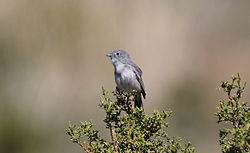



Gray Vireo
Vireo vicinior
Silhouette: Caleb Gordon · PhyloPic
- KingdomAnimalia (Animals)
- PhylumChordata (Chordates)
- ClassAves (Birds)
- OrderPasseriformes (Perching Birds)
- FamilyVireonidae (Vireos, Shrike-Babblers, and Erpornis)
- GenusVireo (Vireos)
- SpeciesVireo vicinior (Gray Vireo)
About the Gray Vireo
The gray vireo (Vireo vicinior) is a small North American passerine bird in the family Vireonidae, the vireos, greenlets, and shrike-babblers. It is found in the southwestern United States and northern Mexico. The gray vireo was originally described in 1866 as Vireo vicinior, its current binomial.
The gray vireo is monotypic. The gray vireo is about 13 to 15 cm (5.1 to 5.9 in) long and weighs 11.5 to 13.5 g (0.41 to 0.48 oz). The sexes have the same plumage. Adults have a mostly gray crown and face with white lores and a thin white eye-ring. Their upperparts are gray that gains a greenish cast late in the year. Their wings are mostly dark gray to blackish with white tips on the greater coverts that form a wing bar. Their tail is gray with white edges on the outer webs of the outer feathers. Their chin, throat, and upper breast are a paler gray than their upperparts; their belly and undertail coverts are white. They have a dark brown iris, a plumbeous or blackish maxilla, a paler grayish blue mandible, and plumbeous or blue-gray legs and feet.
The gray vireo has a disjunct distribution on both its breeding... Wikipedia →
Recent sightings of Gray Vireo in Bahía de Loreto National Park
LIVEiNaturalistClosest Relatives at Bahía de Loreto National Park

 Bell's Vireo
Vireo bellii

Plumbeous Vireo
Vireo plumbeus

 House Finch
Haemorhous mexicanus

 Hooded Oriole
Icterus cucullatus

 Verdin
Auriparus flaviceps

 Northern Mockingbird
Mimus polyglottos

 Cactus Wren
Campylorhynchus brunneicapillus

Blue-gray Gnatcatcher
Polioptila caerulea

 White-crowned Sparrow
Zonotrichia leucophrys

 Orange-crowned Warbler
Leiothlypis celata

 Northern Cardinal
Cardinalis cardinalis

 Ash-throated Flycatcher
Myiarchus cinerascens
Global Distribution
Warmer areas are where this animal is recorded most often.
Parks Where Found
| # | Park | Country | Daily sighting probability |
|---|---|---|---|
| 1 | Bahía de Loreto National Park | 🇲🇽 Mexico | |
| 2 | Saguaro National Park | 🇺🇸 United States | |
| 3 | Cabo Pulmo National Park | 🇲🇽 Mexico | |
| 4 | El Vizcaíno Biosphere Reserve | 🇲🇽 Mexico | |
| 5 | Joshua Tree National Park | 🇺🇸 United States |
Quick answers
What are the chances of seeing a Gray Vireo in Bahía de Loreto National Park?
Under 5% of wildlife watchers report a Gray Vireo sighting in Bahía de Loreto National Park, based on 14 verified sightings from GBIF citizen-science data.
When is the best time to see Gray Vireo in Bahía de Loreto National Park?
September has the highest sighting rate for Gray Vireo in Bahía de Loreto National Park in our monthly data.