

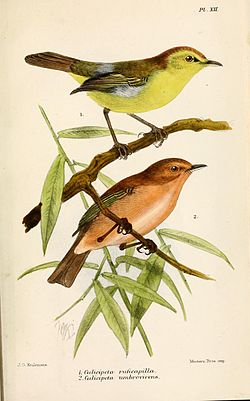


Brown Woodland-Warbler
Phylloscopus umbrovirens
Silhouette: Jiekun He · PhyloPic
- KingdomAnimalia (Animals)
- PhylumChordata (Chordates)
- ClassAves (Birds)
- OrderPasseriformes (Perching Birds)
- FamilyPhylloscopidae (Leaf Warblers)
- GenusPhylloscopus (Leaf Warblers)
- SpeciesPhylloscopus umbrovirens (Brown Woodland-Warbler)
About the Brown Woodland-Warbler
The brown woodland warbler (Phylloscopus umbrovirens) is a species of Old World warbler in the family Phylloscopidae. It is native to the eastern Afromontane. Its natural habitats are boreal forests, subtropical or tropical moist montane forests, and subtropical or tropical dry shrubland.
The range of the brown woodland warbler is quite large, with its extent of occurrence being estimated at 3,990,000 km2 (1,540,000 sq mi). Its population is assumed to be stable, though no accurate estimates of its size have been made. The 2016 IUCN Red List classifies the species as one of least concern. Wikipedia →
Recent sightings of Brown Woodland-Warbler in Bale Mountains National Park
LIVEiNaturalistClosest Relatives at Bale Mountains National Park

 Common Chiffchaff
Phylloscopus collybita

 Willow Warbler
Phylloscopus trochilus

 Abyssinian Thrush
Turdus abyssinicus

 Streaky Seedeater
Crithagra striolata

 Moorland Chat
Pinarochroa sordida

Tacazze Sunbird
Nectarinia tacazze

Baglafecht Weaver
Ploceus baglafecht

Abyssinian Siskin
Serinus nigriceps

 Abyssinian Catbird
Parophasma galinieri

 Thekla Lark
Galerida theklae

Ethiopian Cisticola
Cisticola lugubris

 Heuglin's White-eye
Zosterops poliogastrus
Global Distribution
Warmer areas are where this animal is recorded most often.
Parks Where Found
| # | Park | Country | Daily sighting probability |
|---|---|---|---|
| 1 | Bale Mountains National Park | 🇪🇹 Ethiopia | |
| 2 | Arusha National Park | 🇹🇿 Tanzania | |
| 3 | Aberdare National Park | 🇰🇪 Kenya | |
| 4 | Ngorongoro Conservation Area | 🇹🇿 Tanzania | |
| 5 | Volcanoes National Park | 🇷🇼 Rwanda | |
| 6 | Virunga National Park | 🇨🇩 Democratic Republic of the Congo | |
| 7 | Awash National Park | 🇪🇹 Ethiopia |
Quick answers
What are the chances of seeing a Brown Woodland-Warbler in Bale Mountains National Park?
About 50% of wildlife watchers report a Brown Woodland-Warbler sighting in Bale Mountains National Park, based on 102 verified sightings from GBIF citizen-science data.
When is the best time to see Brown Woodland-Warbler in Bale Mountains National Park?
December has the highest sighting rate for Brown Woodland-Warbler in Bale Mountains National Park in our monthly data.