
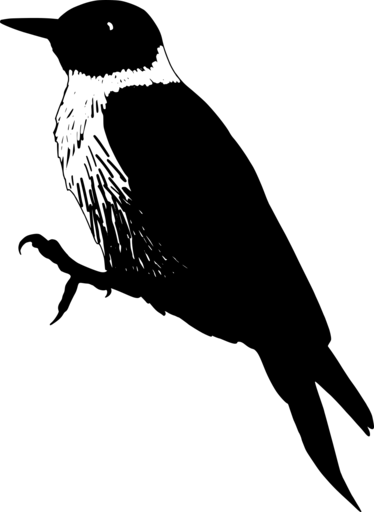
Lewis's Woodpecker
Melanerpes lewis
Silhouette: Richard Rich · PhyloPic
- KingdomAnimalia (Animals)
- PhylumChordata (Chordates)
- ClassAves (Birds)
- OrderPiciformes (Woodpeckers and Allies)
- FamilyPicidae (Woodpeckers)
- GenusMelanerpes (Melanerpes Woodpeckers)
- SpeciesMelanerpes lewis (Lewis's Woodpecker)
About the Lewis's Woodpecker
Lewis's woodpecker (Melanerpes lewis) is a large North American species of woodpecker which ornithologist Alexander Wilson named after Meriwether Lewis. Lewis was one of the explorers who surveyed the areas bought by the United States of America as part of the Louisiana Purchase and first described this species of bird.
Lewis's woodpecker was described and illustrated in 1811 by the American ornithologist Alexander Wilson in his American Ornithology; or, the Natural History of the Birds of the United States. Wilson based his description on some bird skins that had been collected on an expedition across the western portion of the United States led by Meriwether Lewis and William Clark in 1803–1806. Wilson coined the English name "Lewis's woodpecker" and the binomial name Picus torquatus. Unfortunately, the specific epithet was preoccupied by the ringed woodpecker, Celeus torquatus (Boddaert, 1783), so in 1849, the English zoologist George Robert Gray coined a new name, Picus lewis. The type locality is Montana. Lewis's woodpecker is now placed in the genus Melanerpes that was erected by the English ornithologist William Swainson in 1832. The species is monotypic: no subspecies... Wikipedia →
Recent sightings of Lewis's Woodpecker in Banff National Park
LIVEiNaturalistClosest Relatives at Banff National Park

 Northern Flicker
Colaptes auratus

 American Three-toed Woodpecker
Picoides dorsalis

 Pileated Woodpecker
Dryocopus pileatus

 Downy Woodpecker
Dryobates pubescens

 Hairy Woodpecker
Leuconotopicus villosus

 Red-naped Sapsucker
Sphyrapicus nuchalis

 Black-backed Woodpecker
Picoides arcticus

Yellow-bellied Sapsucker
Sphyrapicus varius
Global Distribution
Warmer areas are where this animal is recorded most often.
Parks Where Found
| # | Park | Country | Daily sighting probability |
|---|---|---|---|
| 1 | Saguaro National Park | 🇺🇸 United States | |
| 2 | Yosemite National Park | 🇺🇸 United States |