
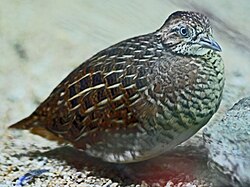



Madagascan Buttonquail
Turnix nigricollis
Silhouette: PhyloPic · PhyloPic
- KingdomAnimalia (Animals)
- PhylumChordata (Chordates)
- ClassAves (Birds)
- OrderCharadriiformes (Shorebirds and Allies)
- FamilyTurnicidae (Buttonquails)
- GenusTurnix (Buttonquail)
- SpeciesTurnix nigricollis (Madagascan Buttonquail)
About the Madagascan Buttonquail
The Madagascar buttonquail or Madagascan buttonquail (Turnix nigricollis) is a species of bird in the buttonquail family, Turnicidae, that is endemic to Madagascar and a few small islands nearby. It is a ground-dwelling species with an unusual breeding biology in which the sexual dimorphism is reversed, with female being more brightly coloured than the male and it is the male that incubates the eggs and mainly cares for the young.
The Madagascar buttonquail was formally described in 1789 by the German naturalist Johann Friedrich Gmelin in his revised and expanded edition of Carl Linnaeus's Systema Naturae. He placed it with grouse like birds in the genus Tetrao and coined the binomial name Tetrao nigricollis. Gmelin based his description on the earlier accounts by the French naturalists Mathurin Jacques Brisson and Georges-Louis Leclerc, Comte de Buffon. The Madagascar buttonquail is now placed in the genus Turnix that was introduced in 1791 by French naturalist in Pierre Bonnaterre. The genus name is an abbreviation of the genus Coturnix. The specific epithet combines the Latin niger meaning "black" with Modern Latin collis meaning "-necked". The species is monotypic... Wikipedia →
Recent sightings of Madagascan Buttonquail in Berenty Reserve
LIVEiNaturalistClosest Relatives at Berenty Reserve


Global Distribution
Warmer areas are where this animal is recorded most often.
Parks Where Found
| # | Park | Country | Daily sighting probability |
|---|---|---|---|
| 1 | Berenty Reserve | 🇲🇬 Madagascar | |
| 2 | Ankarafantsika National Park | 🇲🇬 Madagascar | |
| 3 | Ranomafana National Park | 🇲🇬 Madagascar |
Quick answers
What are the chances of seeing a Madagascan Buttonquail in Berenty Reserve?
About 40% of wildlife watchers report a Madagascan Buttonquail sighting in Berenty Reserve, based on 65 verified sightings from GBIF citizen-science data.
When is the best time to see Madagascan Buttonquail in Berenty Reserve?
July has the highest sighting rate for Madagascan Buttonquail in Berenty Reserve in our monthly data.