Big Bend National Park
🇺🇸 United States
🐦 Roadrunners in the Chihuahuan DesertBig Bend National Park sits in the Chihuahuan Desert of western Texas, United States. The landscape is a mix of rugged canyons, river‑cut valleys and stretches of dry scrub dotted with mesquite and cactus. Its isolation and stark relief set it apart from more vegetated parks.
29.226° N 103.234° W
Wildlife
⭐ Iconic Species
 ★
★  American Black Bear
Ursus americanus
 ★
★  Collared Peccary
Pecari tajacu
 ★
★  Greater Roadrunner
Geococcyx californianus
 ★
★  Western Diamondback Rattlesnake
Crotalus atrox
📊 Most Spotted

 White-winged Dove
Zenaida asiatica

 Northern Mockingbird
Mimus polyglottos

 Turkey Vulture
Cathartes aura

 Common Raven
Corvus corax

 Ladder-backed Woodpecker
Dryobates scalaris

 House Finch
Haemorhous mexicanus

 Cactus Wren
Campylorhynchus brunneicapillus

 Greater Earless Lizard
Cophosaurus texanus

 Pyrrhuloxia
Cardinalis sinuatus

 Yellow-rumped Warbler
Setophaga coronata

 White-tailed Deer
Odocoileus virginianus

 Ash-throated Flycatcher
Myiarchus cinerascens
⭐ Iconic Species
📊 Most Spotted
White-tailed Deer
Odocoileus virginianus

 Coyote
Canis latrans

 Rock Squirrel
Otospermophilus variegatus

 Aoudad
Ammotragus lervia

 Desert Cottontail
Sylvilagus audubonii

 Mule Deer
Odocoileus hemionus

 Gray Fox
Urocyon cinereoargenteus

 Black-tailed Jackrabbit
Lepus californicus

 Bobcat
Lynx rufus

Texas Antelope Squirrel
Ammospermophilus interpres

 Common Raccoon
Procyon lotor

 Pallid Bat
Antrozous pallidus
⭐ Iconic Species
📊 Most Spotted
White-winged Dove
Zenaida asiatica
Northern Mockingbird
Mimus polyglottos
Turkey Vulture
Cathartes aura
Common Raven
Corvus corax
Ladder-backed Woodpecker
Dryobates scalaris
House Finch
Haemorhous mexicanus
Cactus Wren
Campylorhynchus brunneicapillus
Pyrrhuloxia
Cardinalis sinuatus
Yellow-rumped Warbler
Setophaga coronata
Ash-throated Flycatcher
Myiarchus cinerascens

Northern Cardinal
Cardinalis cardinalis

 Canyon Towhee
Melozone fusca
⭐ Iconic Species
📊 Most Spotted
Greater Earless Lizard
Cophosaurus texanus

Canyon Lizard
Sceloporus merriami

 Plateau Spotted Whiptail
Aspidoscelis scalaris
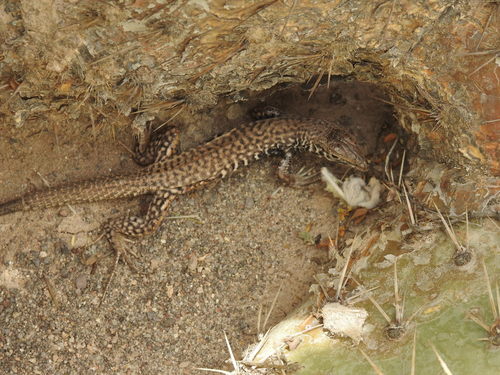
Marbled Whiptail
Aspidoscelis marmoratus

 Eastern Black-tailed Rattlesnake
Crotalus ornatus

 Common Side-blotched Lizard
Uta stansburiana

 Trans-pecos Ratsnake
Bogertophis subocularis

Crevice Spiny Lizard
Sceloporus poinsettii

 Big Bend Slider
Trachemys gaigeae

 Texas Banded Gecko
Coleonyx brevis

 Spiny Softshell Turtle
Apalone spinifera

 Chihuahuan Nightsnake
Hypsiglena jani
📊 Most Spotted

 Red-spotted Toad
Anaxyrus punctatus

 Rio Grande Leopard Frog
Lithobates berlandieri

Texas Toad
Anaxyrus speciosus

 Couch's Spadefoot
Scaphiopus couchii

 Canyon Tree Frog
Dryophytes arenicolor

 American Bullfrog
Lithobates catesbeianus

Green Treefrog
Dryophytes cinereus

Green Toad
Anaxyrus debilis

 Western Narrow-mouthed Toad
Gastrophryne olivacea

 Cliff Chirping Frog
Eleutherodactylus marnockii

Mexican Spadefoot
Spea multiplicata
Recent sightings in Big Bend National Park
LIVEiNaturalistAnimal Events
1Colima Warbler Breeding Season
Colima Warblers migrate from Mexico each spring to breed in the high Chisos Mountains — the only regular US breeding site — arriving and departing by


2Spring Bird Migration
Peak spring migration through the Rio Grande corridor and Chisos in the last two weeks of and first week of , when Big Bend records its greatest diversity of migrant songbirds.


3Hummingbird Season at Mountain Sage Bloom
In late summer the Chisos mountain sage blooms and concentrates hummingbirds — including the US-specialty Lucifer Hummingbird — feeding on the red blossoms


Sighting Calendar
Average chance of spotting the park's most-spotted species, month by month
- 1Colima Warbler Breeding Season
- 2Spring Bird Migration
- 3Hummingbird Season at Mountain Sage Bloom
Sighting Zones
Warmer areas are where all species together are recorded most often.
Essentials
Climate
What visitors saw
In other parts of the park, we heard northern cardinals, pyrrhuloxia, and cactus wrens calling endlessly.
The next morning while we sat outside our cabin, enjoying the cooler morning temperatures and drinking coffee, we observed a Lark Bunting foraging nearby.
While on our way to the park, we saw a gray fox run across the road.
Quick answers
What animals can you see in Big Bend National Park?
The most likely sightings are White-winged Dove (seen by about 70% of wildlife watchers), Northern Mockingbird (seen by about 70% of wildlife watchers), Turkey Vulture (seen by about 70% of wildlife watchers), Common Raven (seen by about 60% of wildlife watchers), Ladder-backed Woodpecker (seen by about 60% of wildlife watchers) — among 784 recorded vertebrate species, based on citizen-science data from GBIF.
When is the best time to visit Big Bend National Park for wildlife?
May has the highest combined sighting rate for the park's top species in our month-by-month GBIF data. The full sighting calendar on this page shows each species' best months.
Can you see American Black Bear in Big Bend National Park?
Yes — about 40% of wildlife watchers report a American Black Bear sighting in Big Bend National Park, based on 250 verified sightings from GBIF citizen-science data.
Can you see Collared Peccary in Big Bend National Park?
Yes — about 40% of wildlife watchers report a Collared Peccary sighting in Big Bend National Park, based on 253 verified sightings from GBIF citizen-science data.
Can you see Greater Roadrunner in Big Bend National Park?
Yes — about 60% of wildlife watchers report a Greater Roadrunner sighting in Big Bend National Park, based on 4,537 verified sightings from GBIF citizen-science data.
Can you see Western Diamondback Rattlesnake in Big Bend National Park?
Yes — about 50% of wildlife watchers report a Western Diamondback Rattlesnake sighting in Big Bend National Park, based on 409 verified sightings from GBIF citizen-science data.
Where Wildlife Score
How good is this park for seeing wildlife?Biodiversity
Very goodHow rich is the wildlife?
Sighting
GoodHow likely to see animals?
Experience
GoodHow easy and pleasant is the visit?
Explore Other Parks
 📍 340 km 🦎 Roundtail Horned Lizard Canyon Trails
 Guadalupe Mountains National Park
📍 773 km 🦎 Desert Spiny Lizard Thrives Among Saguaro Giants Saguaro National Park
 📍 857 km 🐋 Blue Whales in the Gulf of California
 Bahía de Loreto National Park
 📍 891 km 🦭 Mexico's Finest Sea Lion Sanctuary