



Graham's Anole
Anolis grahami
Silhouette: Beth Reinke · PhyloPic
- KingdomAnimalia (Animals)
- PhylumChordata (Chordates)
- ClassSquamata
- FamilyDactyloidae
- GenusAnolis (Anoles)
- SpeciesAnolis grahami (Graham's Anole)
About the Graham's Anole
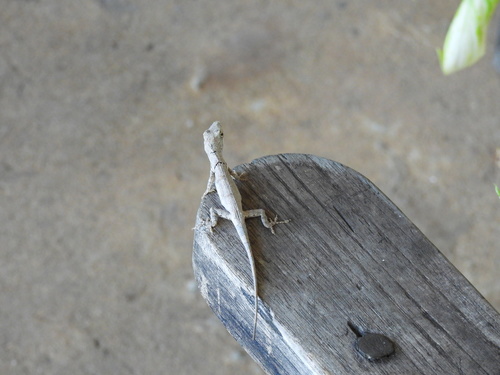
Anolis grahami, commonly known as the Jamaican turquoise anole and Graham's anole, is a species of lizard in the family Dactyloidae. The species is native to the island of Jamaica, and has also been introduced to the territory of Bermuda. It is one of many different species of anole lizards found in Jamaica. There are two recognized subspecies.
The specific name of this species, grahami, was assigned to it in honor of James Duncan Graham, who founded the Corps of Topographical Engineers in the United States Army. The upper body of Anolis grahami is usually a rich emerald or aquamarine while its trunk and legs are a bright deep blue. It has a bright orange dewlap. The first half of the tail is a deep blue, while the lower half is brilliant violet. Its underside is usually a light blue gray. Occasionally, especially in females and younger individuals, these colors may be somewhat muted, though still quite gaudy. Fully grown males can be exceptionally colorful; occasionally a pure turquoise blue lizard may be observed.
Mature male Anolis grahami can grow to a total length of 16 centimetres (6.3 in) and a snout–vent length (SVL) of 8 cm (3.1 in); females... Wikipedia →
Recent sightings of Graham's Anole in Blue and John Crow Mountains National Park
LIVEiNaturalistClosest Relatives at Blue and John Crow Mountains National Park




Global Distribution
Warmer areas are where this animal is recorded most often.
Parks Where Found
| # | Park | Country | Daily sighting probability |
|---|---|---|---|
| 1 | Blue and John Crow Mountains National Park | 🇯🇲 Jamaica |
More parks will be added in future updates.
Quick answers
What are the chances of seeing a Graham's Anole in Blue and John Crow Mountains National Park?
About 40% of wildlife watchers report a Graham's Anole sighting in Blue and John Crow Mountains National Park, based on 5 verified sightings from GBIF citizen-science data.
When is the best time to see Graham's Anole in Blue and John Crow Mountains National Park?
May has the highest sighting rate for Graham's Anole in Blue and John Crow Mountains National Park in our monthly data.