

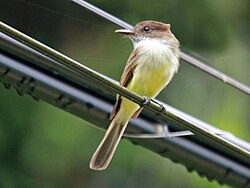



Sad Flycatcher
Myiarchus barbirostris
Silhouette: Ferran Sayol · PhyloPic
- KingdomAnimalia (Animals)
- PhylumChordata (Chordates)
- ClassAves (Birds)
- OrderPasseriformes (Perching Birds)
- FamilyTyrannidae (Tyrant Flycatchers)
- GenusMyiarchus (Myiarchus Flycatchers)
- SpeciesMyiarchus barbirostris (Sad Flycatcher)
About the Sad Flycatcher
The sad flycatcher (Myiarchus barbirostris) is a species of bird in the family Tyrannidae, the tyrant flycatchers. It is endemic to Jamaica. The sad flycatcher was originally described as Tyrannula barbirostris. The type specimen was mistakenly described as being taken in Mexico.
The sad flycatcher is monotypic. The sad flycatcher is 16.5 to 17 cm (6.5 to 6.7 in) long and weighs 11.5 to 16 g (0.41 to 0.56 oz). The sexes have the same plumage. Adults have a smoky olive-brown crown and face; the crown feathers form a crest. Their upperparts are more olive with rufous-tinged olive-brown uppertail coverts. Their wings are mostly brown with pale grayish edges on the tertials. Their greater and median wing coverts have a rufous tinge that forms faint wing bars. Their tail is mostly brown with rufous on the outer webs of some feathers. Their throat and upper breast are gray to pale whitish and their lower breast, belly, and undertail coverts lemon-yellow. They have a dark iris, bill, and legs and feet. Juveniles have entirely gray underparts.
The sad flycatcher is found throughout most of Jamaica. It primarily... Wikipedia →
Recent sightings of Sad Flycatcher in Blue and John Crow Mountains National Park
LIVEiNaturalistClosest Relatives at Blue and John Crow Mountains National Park

 Rufous-tailed Flycatcher
Myiarchus validus

Stolid Flycatcher
Myiarchus stolidus

 Loggerhead Kingbird
Tyrannus caudifasciatus

 Jamaican Pewee
Contopus pallidus

 Jamaican Elaenia
Myiopagis cotta

Gray Kingbird
Tyrannus dominicensis

 Greater Antillean Elaenia
Elaenia fallax

 Bananaquit
Coereba flaveola

 White-chinned Thrush
Turdus aurantius

 Jamaican Spindalis
Spindalis nigricephala

Orangequit
Euneornis campestris

 American Redstart
Setophaga ruticilla
Global Distribution
Warmer areas are where this animal is recorded most often.
Parks Where Found
| # | Park | Country | Daily sighting probability |
|---|---|---|---|
| 1 | Blue and John Crow Mountains National Park | 🇯🇲 Jamaica |
More parks will be added in future updates.
Quick answers
What are the chances of seeing a Sad Flycatcher in Blue and John Crow Mountains National Park?
About 70% of wildlife watchers report a Sad Flycatcher sighting in Blue and John Crow Mountains National Park, based on 604 verified sightings from GBIF citizen-science data.
When is the best time to see Sad Flycatcher in Blue and John Crow Mountains National Park?
March has the highest sighting rate for Sad Flycatcher in Blue and John Crow Mountains National Park in our monthly data.