

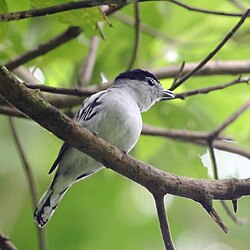

Black-capped Becard
Pachyramphus marginatus
Silhouette: Sheatherius · PhyloPic
- KingdomAnimalia (Animals)
- PhylumChordata (Chordates)
- ClassAves (Birds)
- OrderPasseriformes (Perching Birds)
- FamilyCotingidae (Cotingas)
- GenusPachyramphus (Becards)
- SpeciesPachyramphus marginatus (Black-capped Becard)
About the Black-capped Becard
The black-capped becard (Pachyramphus marginatus) is a species of bird in the family Tityridae, the tityras, becards, and allies. It is found in Bolivia, Brazil, Colombia, Ecuador, French Guiana, Guyana, Peru, Suriname, and Venezuela.
The black-capped becard was originally described in 1823 as Todus marginatus, mistakenly placing it among the todies. It was eventually placed in its present genus Pachyramphus. That genus has variously been assigned to the tyrant flycatcher family Tyrannidae and the cotinga family Cotingidae. Several early twenty-first century studies confirmed the placement of Pachyramphus in Tityridae and taxonomic systems made the reassignment.
The black-capped becard has two subspecies, the nominate P. m. marginatus (Lichtenstein, MHC, 1823) and P. m. nanus (Bangs & Penard, 1921). The black-capped becard is 13 to 14 cm (5.1 to 5.5 in) long and weighs about 18 g (0.63 oz). Adult males of the nominate subspecies have a glossy black crown that has a blue sheen and a scaly appearance. They have a pale spot above the lores and a thin whitish eye-ring on an otherwise light gray face. The gray of their face wraps around their... Wikipedia →
Recent sightings of Black-capped Becard in Brownsberg Nature Park
LIVEiNaturalistClosest Relatives at Brownsberg Nature Park

 Pink-throated Becard
Pachyramphus minor

 Screaming Piha
Lipaugus vociferans

 Wing-barred Piprites
Piprites chloris

Russet-winged Schiffornis
Schiffornis turdina

Cinereous Mourner
Laniocera hypopyrra

Pompadour Cotinga
Xipholena punicea

Black-tailed Tityra
Tityra cayana

Sharpbill
Oxyruncus cristatus

Spangled Cotinga
Cotinga cayana

Capuchinbird
Perissocephalus tricolor

Purple-throated Fruitcrow
Querula purpurata

Black-crowned Tityra
Tityra inquisitor
Global Distribution
Warmer areas are where this animal is recorded most often.
Parks Where Found
| # | Park | Country | Daily sighting probability |
|---|---|---|---|
| 1 | Serra dos Órgãos National Park | 🇧🇷 Brazil | |
| 2 | Amacayacu National Natural Park | 🇨🇴 Colombia | |
| 3 | Anavilhanas National Park | 🇧🇷 Brazil | |
| 4 | Tambopata National Reserve | 🇵🇪 Peru | |
| 5 | Brownsberg Nature Park | 🇸🇷 Suriname | |
| 6 | Yasuní National Park | 🇪🇨 Ecuador | |
| 7 | Cuyabeno Wildlife Reserve | 🇪🇨 Ecuador | |
| 8 | Manu National Park | 🇵🇪 Peru | |
| 9 | Canaima National Park | 🇻🇪 Venezuela | |
| 10 | Amboró National Park | 🇧🇴 Bolivia | |
| 11 | Sierra de la Macarena National Park | 🇨🇴 Colombia |
Quick answers
What are the chances of seeing a Black-capped Becard in Brownsberg Nature Park?
Under 5% of wildlife watchers report a Black-capped Becard sighting in Brownsberg Nature Park, based on 6 verified sightings from GBIF citizen-science data.
When is the best time to see Black-capped Becard in Brownsberg Nature Park?
January has the highest sighting rate for Black-capped Becard in Brownsberg Nature Park in our monthly data.