
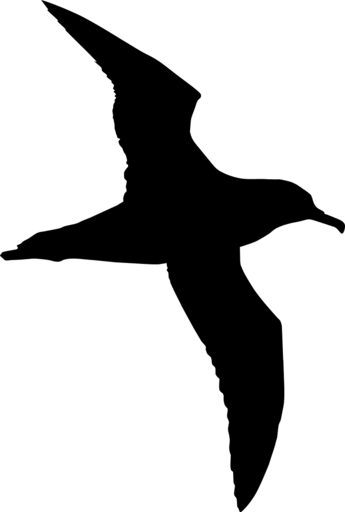
Black-vented Shearwater
Puffinus opisthomelas
Silhouette: Juan Carlos Jerí · PhyloPic
- KingdomAnimalia (Animals)
- PhylumChordata (Chordates)
- ClassAves (Birds)
- OrderProcellariiformes (Tubenoses)
- FamilyProcellariidae (Shearwaters and Petrels)
- GenusPuffinus (Small Shearwaters)
- SpeciesPuffinus opisthomelas (Black-vented Shearwater)
About the Black-vented Shearwater
The black-vented shearwater (Puffinus opisthomelas) is a species of seabird endemic to islands off of the Pacific coast of Mexico and the Gulf of California. It is a smaller shearwater, with a length of 30–38 cm, 76–89 cm wingspan and a mass of around 400 g. This species is pelagic and feeds mainly on small fish. It is nocturnal, and is most active in low light settings.
The name "puffin" is thought to originate from the Middle English term "pophyn," which was used in the Middle Ages to describe the fatty, preserved young shearwaters that were prepared as food. Since shearwaters and Atlantic puffins (Fratercula arctica) often nest in close proximity, the name 'puffin' was mistakenly applied to the Atlantic puffin. Over time, the name stuck, and today it is used for the Atlantic puffin species. The name "puffin" also remained associated with the shearwaters and the genus Puffinus.
The black-vented shearwater is one of around 21 other species in the genus Puffinus, eight of which reside in North and Middle America (see Christmas shearwater, Galápagos shearwater, Manx shearwater, Townsend's shearwater, Newell's shearwater, Bryan's shearwater, Sargasso shearwater... Wikipedia →
Recent sightings of Black-vented Shearwater in Cabo Pulmo National Park
LIVEiNaturalistClosest Relatives at Cabo Pulmo National Park

 Pink-footed Shearwater
Puffinus creatopus

 Wedge-tailed Shearwater
Puffinus pacificus

Sooty Shearwater
Puffinus griseus

 Cook's Petrel
Pterodroma cookii

Juan Fernández Petrel
Pterodroma externa

 Black Storm-Petrel
Hydrobates melania

 Least Storm-Petrel
Oceanodroma microsoma

Wedge-rumped Storm-Petrel
Oceanodroma tethys
Global Distribution
Warmer areas are where this animal is recorded most often.
Parks Where Found
| # | Park | Country | Daily sighting probability |
|---|---|---|---|
| 1 | El Vizcaíno Biosphere Reserve | 🇲🇽 Mexico | |
| 2 | Bahía de Loreto National Park | 🇲🇽 Mexico | |
| 3 | Cabo Pulmo National Park | 🇲🇽 Mexico |