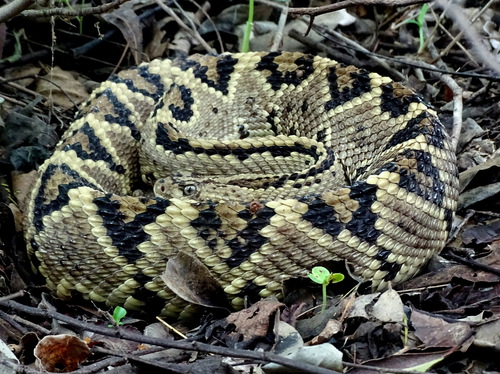

Tehuantepec Isthmus Neotropical Rattlesnake
Crotalus ehecatl
Silhouette: Bill Bouton (source photo) & T. Michael Keesey (vectorization) · PhyloPic
- KingdomAnimalia (Animals)
- PhylumChordata (Chordates)
- ClassSquamata
- FamilyViperidae (Vipers)
- GenusCrotalus (Rattlesnakes)
- SpeciesCrotalus ehecatl (Tehuantepec Isthmus Neotropical Rattlesnake)
About the Tehuantepec Isthmus Neotropical Rattlesnake
Crotalus ehecatl, the Tehuantepec Isthmus Neotropical rattlesnake, is a species of venomous snake in the genus Crotalus found in Mexico. The specific name, ehecatl, comes from the Nahuatl word "Ehēcatl" meaning "the wind" or "Lord of the wind", referring to the Aztec deity associated with wind.
Crotalus ehecatl is a large and heavy-bodied snake, with adults reaching lengths of up to 165.3 cm (approximately 65 inches). The body pattern consists of a series of dark, diamond-shaped blotches on a lighter background, which can vary from gray to brown. The head features a distinctive lance-shaped pattern.
This species exhibits some levels of sexual dimorphism, with males having significantly longer tails than females. Males also have more subcaudal and anterior intersupraocular scales. On the other hand, the species displays no sexual dimorphism when related to snout-vent length or head length. Its method of reproduction is ovoviviparous.
The diet consists primarily of mammals, with feeding occurring mainly during the rainy season as it is related to reproduction. Additionally, mammals eaten can belong to any stage of life, accounting for the species' large... Wikipedia →
Recent sightings of Tehuantepec Isthmus Neotropical Rattlesnake in Cañón del Sumidero National Park
LIVEiNaturalistClosest Relatives at Cañón del Sumidero National Park


Global Distribution
Warmer areas are where this animal is recorded most often.
Parks Where Found
| # | Park | Country | Daily sighting probability |
|---|---|---|---|
| 1 | Cañón del Sumidero National Park | 🇲🇽 Mexico |
More parks will be added in future updates.