

Big Free-tailed Bat
Nyctinomops macrotis
Silhouette: T. Michael Keesey · PhyloPic
- KingdomAnimalia (Animals)
- PhylumChordata (Chordates)
- ClassMammalia (Mammals)
- OrderChiroptera (Bats)
- FamilyMolossidae (Free-tailed Bats)
- GenusNyctinomops
- SpeciesNyctinomops macrotis (Big Free-tailed Bat)
About the Big Free-tailed Bat
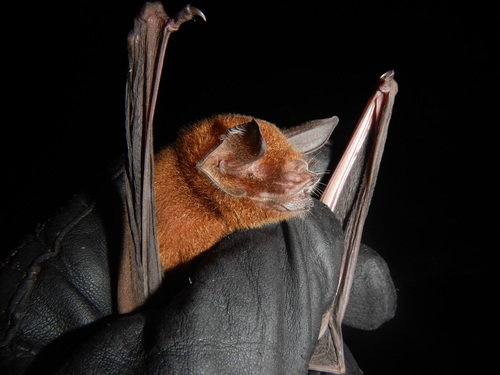
The big free-tailed bat (Nyctinomops macrotis) is a bat species found in the Americas. It was described as a new species in 1839 by British zoologist John Edward Gray. Gray placed it in the now-defunct genus Nyctinomus, with a binomial of Nyctinomus macrotis. The holotype had been collected in Cuba by William Sharp Macleay.
It is the largest member of Nyctinomops, with an average forearm length of 60 mm (2.4 in). Individuals weigh approximately 20.6 g (0.73 oz). It has a wingspan of 417–436 mm (16.4–17.2 in). Its fur is glossy and variable in color, ranging from pale, reddish brown to dark brown or blackish. Its dental formula is 1.1.2.32.1.2.3 for a total of 30 teeth.
Based on its wing morphology, it likely has a rapid flight. Its flight speed could exceed 40 km/h (25 mph). Its range includes many countries in North, Central, and South America, including: Argentina, Brazil, Canada, Colombia, Cuba, the Dominican Republic, Ecuador, French Guiana, Guyana, Haiti, Jamaica, Mexico, Suriname, the United States, and Venezuela. It is possibly also found in Uruguay. The individuals documented in Canada and the... Wikipedia →
Recent sightings of Big Free-tailed Bat in Chapada dos Guimarães National Park
LIVEiNaturalistClosest Relatives at Chapada dos Guimarães National Park




Global Distribution
Warmer areas are where this animal is recorded most often.
Parks Where Found
| # | Park | Country | Daily sighting probability |
|---|---|---|---|
| 1 | Chapada dos Guimarães National Park | 🇧🇷 Brazil |
More parks will be added in future updates.