
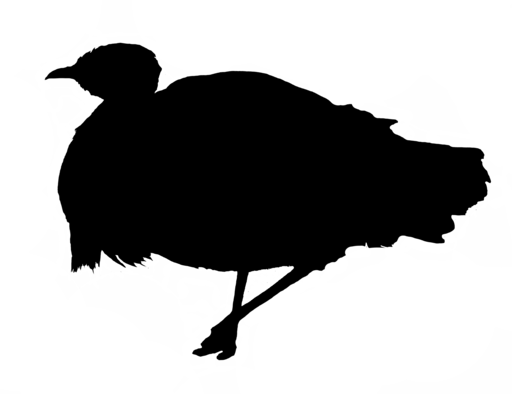
Bengal Florican
Houbaropsis bengalensis
Silhouette: Kai Caspar · PhyloPic
- KingdomAnimalia (Animals)
- PhylumChordata (Chordates)
- ClassAves (Birds)
- OrderOtidiformes (Bustards)
- FamilyOtididae (Bustards)
- GenusHoubaropsis (Bengal Floricans)
- SpeciesHoubaropsis bengalensis (Bengal Florican)
About the Bengal Florican
The Bengal florican (Houbaropsis bengalensis), also called the Bengal bustard, is a bustard species native to the Indian subcontinent, Cambodia, and Vietnam. It is listed as Critically Endangered on the IUCN Red List because fewer than 1,000 individuals were estimated to be alive as of 2017. It is the only member of the genus Houbaropsis.
The male Bengal florican has a black plumage from the head and neck to underparts. Its head carries a long lanky crest, and the neck has elongated display plumes. The upperside is buff with fine black vermiculations and black arrowhead markings, and there is a conspicuous large white patch from the wing coverts to the remiges. In flight, the male's wings appear entirely white except for the dark primary remiges. The feet and legs are yellow, the bill and irides are dark. The female is buff-brown similar to the males' back with a dark brown crown and narrow dark streaks down the side of the neck. Her wing coverts are lighter than the remiges and covered in fine dark barring. Immature Bengal floricans look like a female.
Adult Bengal floricans range from 66–68 cm (26–27 in) in length and stand around 55 cm (22 in) tall. The female is... Wikipedia →
Recent sightings of Bengal Florican in Chitwan National Park
LIVEiNaturalistGlobal Distribution
Warmer areas are where this animal is recorded most often.
Parks Where Found
| # | Park | Country | Daily sighting probability |
|---|---|---|---|
| 1 | Manas National Park | 🇮🇳 India | |
| 2 | Royal Manas National Park | 🇧🇹 Bhutan | |
| 3 | Kaziranga National Park | 🇮🇳 India | |
| 4 | Chitwan National Park | 🇳🇵 Nepal |