



Southern Cricket Frog
Acris gryllus
Silhouette: Dmitry Bogdanov (vectorized by T. Michael Keesey) · PhyloPic
- KingdomAnimalia (Animals)
- PhylumChordata (Chordates)
- ClassAmphibia (Amphibians)
- OrderAnura (Frogs and Toads)
- FamilyHylidae (Hylid Tree Frogs)
- GenusAcris (Cricket Frogs)
- SpeciesAcris gryllus (Southern Cricket Frog)
About the Southern Cricket Frog
The southern cricket frog or southeastern cricket frog (Acris gryllus) is a small hylid frog native to the Southeastern United States. It is very similar in appearance and habits to the northern cricket frog, Acris crepitans, and was considered formerly conspecific (Dickerson 1906). The scientific name Acris is from the Greek word for locust, and the species name gryllus is Latin for cricket (Georgia Wildlife).
At 0.75–1.5 inches (16–32 mm) in length, Acris gryllus is even smaller than A. crepitans. Other characters that differentiate the southern species are: More pointed snout--A. crepitans more blunt. Hind leg is more than half length of the body when folded—that of A. crepitans is less than one half body length. When rear leg is extended forward, the heel of A. gryllus usually reaches beyond the snout—does not reach snout in A. crepitans.
A. gryllus can jump longer distances than A. crepitans. A. gryllus has a sharply defined black stripe on the back of the thigh--A. crepitans has a ragged stripe. Webbing on rear feet of A. gryllus is sparse, more extensive in A. crepitans.
There is evidence that the color of the vertebral stripe on southern cricket frogs can... Wikipedia →
Recent sightings of Southern Cricket Frog in Congaree National Park
LIVEiNaturalistClosest Relatives at Congaree National Park

 Green Treefrog
Dryophytes cinereus

Cope's Gray Tree Frog
Dryophytes chrysoscelis

Squirrel Tree Frog
Dryophytes squirellus

 Spring Peeper
Pseudacris crucifer

Pine Wood Treefrog
Dryophytes femoralis

Barking Treefrog
Dryophytes gratiosus

Brimley's Chorus Frog
Pseudacris brimleyi

Southern Chorus Frog
Pseudacris nigrita

 Southern Toad
Anaxyrus terrestris

 Southern Leopard Frog
Lithobates sphenocephalus
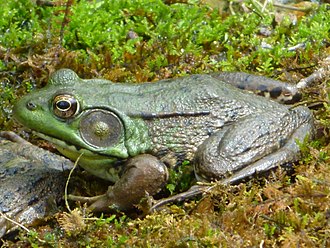
Green Frog
Lithobates clamitans

 Eastern Narrow-mouthed Toad
Gastrophryne carolinensis
Global Distribution
Warmer areas are where this animal is recorded most often.
Parks Where Found
| # | Park | Country | Daily sighting probability |
|---|---|---|---|
| 1 | Big Cypress National Preserve | 🇺🇸 United States | |
| 2 | Everglades National Park | 🇺🇸 United States | |
| 3 | Congaree National Park | 🇺🇸 United States |