
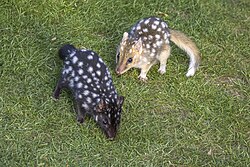



Eastern Quoll
Dasyurus viverrinus
Silhouette: Sarah Werning · PhyloPic
- KingdomAnimalia (Animals)
- PhylumChordata (Chordates)
- ClassMammalia (Mammals)
- OrderDasyuromorphia (Carnivorous Marsupials)
- FamilyDasyuridae (Dasyurids)
- GenusDasyurus (Quolls)
- SpeciesDasyurus viverrinus (Eastern Quoll)
About the Eastern Quoll
The eastern quoll (Dasyurus viverrinus, formerly known as the eastern native cat) is a medium-sized, carnivorous marsupial (dasyurid), and one of six extant species of quolls. Endemic to Australia, they occur on the island state of Tasmania, but were considered extinct on the mainland after 1963. The species has been reintroduced to fox-proof fenced sanctuaries in Victoria in 2003 and to the Australian Capital Territory in 2016.
The eastern quoll is a member of the family Dasyuridae, which includes most carnivorous marsupials. Its species name, viverrinus, indicates it is "ferret-like". No subspecies are recognised. Eastern quolls are about the size of a small domestic cat, with adult males measuring 53 to 66 cm (21 to 26 in) in total length, including the 20 to 28 cm (7.9 to 11.0 in) tail, and having an average weight of 1.1 kg (2.4 lb). Females are significantly smaller, measuring 48 to 58 cm (19 to 23 in), including a 17 to 24 cm (6.7 to 9.4 in) tail, and weighing around 0.7 kg (1.5 lb). They have a tapering snout, short legs, and erect ears. They can be distinguished from all other species of quolls by the presence of only four toes, rather than... Wikipedia →
Recent sightings of Eastern Quoll in Cradle Mountain-Lake St Clair National Park
LIVEiNaturalistClosest Relatives at Cradle Mountain-Lake St Clair National Park


Global Distribution
Warmer areas are where this animal is recorded most often.
Parks Where Found
| # | Park | Country | Daily sighting probability |
|---|---|---|---|
| 1 | Cradle Mountain-Lake St Clair National Park | 🇦🇺 Australia | |
| 2 | Booderee National Park | 🇦🇺 Australia |
Quick answers
What are the chances of seeing a Eastern Quoll in Cradle Mountain-Lake St Clair National Park?
About 40% of wildlife watchers report a Eastern Quoll sighting in Cradle Mountain-Lake St Clair National Park, based on 31 verified sightings from GBIF citizen-science data.
When is the best time to see Eastern Quoll in Cradle Mountain-Lake St Clair National Park?
June has the highest sighting rate for Eastern Quoll in Cradle Mountain-Lake St Clair National Park in our monthly data.