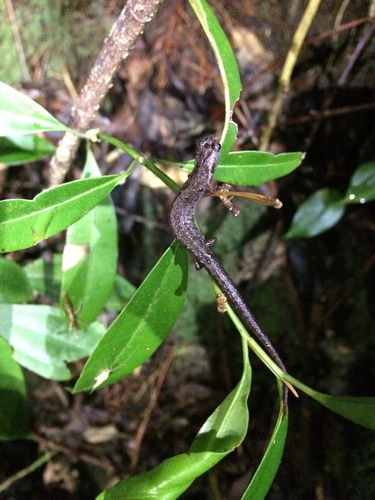
Merendon Moss Salamander
Nototriton brodiei
Silhouette: C. Camilo Julián-Caballero · PhyloPic
- KingdomAnimalia (Animals)
- PhylumChordata (Chordates)
- ClassAmphibia (Amphibians)
- OrderCaudata (Salamanders)
- FamilyPlethodontidae (Lungless Salamanders)
- GenusNototriton (Moss Salamanders)
- SpeciesNototriton brodiei (Merendon Moss Salamander)
About the Merendon Moss Salamander
Nototriton brodiei is a species of salamander in the family Plethodontidae. It is endemic to the Sierra del Merendón and known from its type locality, Sierra de Caral in Izabal Department, eastern Guatemala, and from the Cusuco National Park in northwestern Honduras. The specific name brodiei honors Edmund D. Brodie Jr., an American herpetologist. Common name Cerro Pozo de Agua moss salamander has been coined for it.
Females in the type series measure 32–34.5 mm (1.26–1.36 in) in snout–vent length. The tail length is about 1.4 times the body length, giving a maximum total length of 84 mm (3.3 in). The snout is broadly rounded and the eyes are protuberant. The head is just slightly wider than the neck. The parotoid glands are weakly developed. The limbs are short and slender. Both the fingers and the toes are about half-webbed and have sub-digital pads. The dorsum is mahogany or rust-brown and bears dark brown chevrons. The underside is blackish or dark purplish brown and has cream flecks. The tail irregular black or dark brown markings on the sides and ventrally. The iris is bronze.
Nototriton brodiei occurs in subtropical old-growth... Wikipedia →
Recent sightings of Merendon Moss Salamander in Cusuco National Park
LIVEiNaturalistClosest Relatives at Cusuco National Park
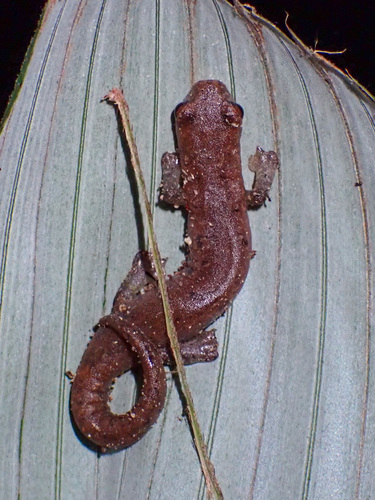
 Nymph Salamander
Bolitoglossa nympha
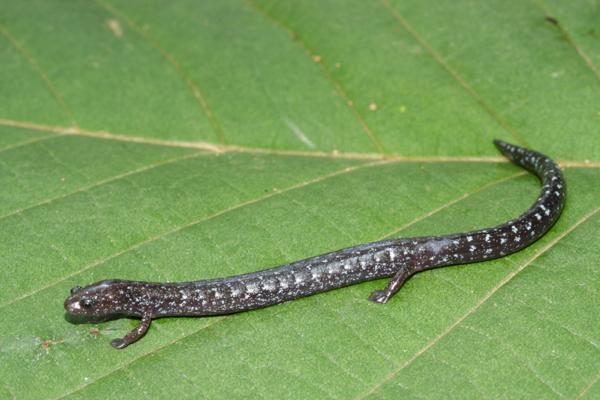
 Central American Worm Salamander
Oedipina elongata

Mexican Mushroomtongue Salamander
Bolitoglossa mexicana

Conant's Mushroomtongue Salamander
Bolitoglossa conanti

Cusuco Worm Salamander
Oedipina tomasi

Rufescent Salamander
Bolitoglossa rufescens

Giant Palm Salamander
Bolitoglossa dofleini

El Cusuco salamander
Bolitoglossa diaphora
Global Distribution
Warmer areas are where this animal is recorded most often.
Parks Where Found
| # | Park | Country | Daily sighting probability |
|---|---|---|---|
| 1 | Cusuco National Park | 🇭🇳 Honduras |
More parks will be added in future updates.