



Mountain Keelback
Helicops angulatus
Silhouette: Alex Slavenko · PhyloPic
- KingdomAnimalia (Animals)
- PhylumChordata (Chordates)
- ClassSquamata
- FamilyColubridae (Colubrid Snakes)
- GenusHelicops (Mountain Keelbacks)
- SpeciesHelicops angulatus (Mountain Keelback)
About the Mountain Keelback
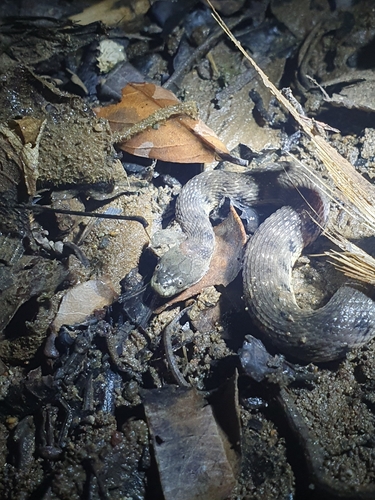
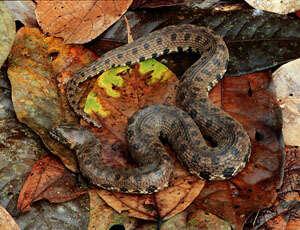
The brown-banded water snake (Helicops angulatus) is a species of aquatic snake found in tropical South America and Trinidad and Tobago. It is also known as the water mapepire. The brown-banded water snake grows to a maximum total length (including tail) of 78 cm (31 inches), although a female measuring 113 cm in has been reported in Bahia state, Brazil. Dorsally, it is olive or gray-brown, with dark brown, black-edged crossbands, which narrow at the sides, and are usually confluent with the black crossbands of the belly. There is a large dark rhomboid on the nape. Ventrally, it is yellowish (in alcohol) with black crossbands or black spots.
The dorsal scales are strongly keeled, even on the occiput and nape, and are arranged in 19 rows. Ventrals are 102–130 in number, the anal scale is divided, and the 61-94 subcaudals are paired and keeled. H. angulatus lives in fresh and brackish water, where it feeds on fish (such as freshwater eels) and possibly also frogs (such as rusty tree frogs, map tree frogs, Manaus slender-legged tree frogs, Scinax ruber, Adenomera hylaedactyla, Rhinella margaritifera, and cane toads) and their eggs, tadpoles, lizards... Wikipedia →
Recent sightings of Mountain Keelback in Cuyabeno Wildlife Reserve
LIVEiNaturalistClosest Relatives at Cuyabeno Wildlife Reserve
 Shreve's Keelback
Helicops pastazae
Hagmann's Keelback
Helicops hagmanni

 Blunthead Tree Snake
Imantodes cenchoa

 Wagler's Sipo
Chironius scurrulus

Catesby's Snail-eater
Dipsas catesbyi

Diurnal Vine Snake
Xenoxybelis argenteus

South American Sipo
Chironius multiventris

Tropical Flat Snake
Siphlophis compressus

Wucherer's Ground Snake
Xenopholis scalaris

 Banded Cat-eyed Snake
Leptodeira annulata

Northern Woodland Racer
Drymoluber dichrous

Brown Sipo
Chironius fuscus
Global Distribution
Warmer areas are where this animal is recorded most often.
Parks Where Found
| # | Park | Country | Daily sighting probability |
|---|---|---|---|
| 1 | Yasuní National Park | 🇪🇨 Ecuador | |
| 2 | Cuyabeno Wildlife Reserve | 🇪🇨 Ecuador | |
| 3 | Tambopata National Reserve | 🇵🇪 Peru | |
| 4 | Manu National Park | 🇵🇪 Peru | |
| 5 | Canaima National Park | 🇻🇪 Venezuela | |
| 6 | Madidi National Park | 🇧🇴 Bolivia | |
| 7 | Amboró National Park | 🇧🇴 Bolivia | |
| 8 | Caroni Swamp | 🇹🇹 Trinidad and Tobago | |
| 9 | Sierra de la Macarena National Park | 🇨🇴 Colombia | |
| 10 | Anavilhanas National Park | 🇧🇷 Brazil | |
| 11 | Amacayacu National Natural Park | 🇨🇴 Colombia |
Quick answers
What are the chances of seeing a Mountain Keelback in Cuyabeno Wildlife Reserve?
About 10% of wildlife watchers report a Mountain Keelback sighting in Cuyabeno Wildlife Reserve, based on 20 verified sightings from GBIF citizen-science data.
When is the best time to see Mountain Keelback in Cuyabeno Wildlife Reserve?
April has the highest sighting rate for Mountain Keelback in Cuyabeno Wildlife Reserve in our monthly data.