

Greater Sea Snake
Hydrophis major
Silhouette: Dr Christina Zdenek · PhyloPic
- KingdomAnimalia (Animals)
- PhylumChordata (Chordates)
- ClassSquamata
- FamilyElapidae (Elapid Snakes)
- GenusHydrophis (Typical Sea Snakes)
- SpeciesHydrophis major (Greater Sea Snake)
About the Greater Sea Snake
The olive-headed sea snake (Hydrophis major), also known as the greater sea snake, is a species of venomous sea snake in the family Elapidae. It is found in the eastern Indian and western central Pacific Ocean in the waters off southern New Guinea, New Caledonia, and Australia (New South Wales, Northern Territory, Queensland, and Western Australia).
Yellowish or pale brownish dorsally, with darker brown or blackish crossbars. Crossbars may be all the same width, or they may be alternately broad and narrow. White ventrally, with or without small dark brown spots. Adults may attain a total length of 105 cm (3 ft 5+3⁄8 in), with a tail 12 cm (4+3⁄4 in) long.
Dorsal scales imbricate (overlapping), strongly keeled on the neck, weakly keeled on the body; arranged in 31–36 rows around the neck, in 36 to 41 rows at midbody. Ventrals 200–236. Head moderate. Body stout. Rostral as broad as deep. Nasals shorter than the frontal, more than twice as long as the suture between the prefrontals. Frontal longer than broad, as long as its distance from the end of the snout. One preocular and two postoculars. Two superposed anterior temporals. Seven or eight upper... Wikipedia →
Recent sightings of Greater Sea Snake in Daintree National Park
LIVEiNaturalistClosest Relatives at Daintree National Park

 Bar-bellied Sea Snake
Hydrophis elegans

 Red-bellied Black Snake
Pseudechis porphyriacus

Small-eyed Snake
Cryptophis nigrescens

Black-bellied Swamp Snake
Hemiaspis signata

Rough-scaled Snake
Tropidechis carinatus

Northern Death Adder
Acanthophis praelongus
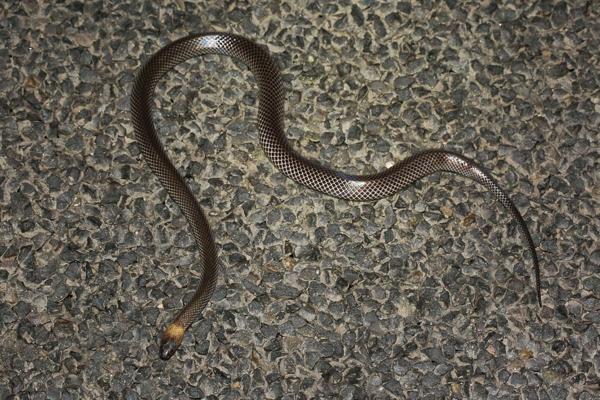
Grey-naped Snake
Furina tristis

 Olive Sea Snake
Aipysurus laevis

Black Whip Snake
Demansia vestigiata
Global Distribution
Warmer areas are where this animal is recorded most often.
Parks Where Found
| # | Park | Country | Daily sighting probability |
|---|---|---|---|
| 1 | Daintree National Park | 🇦🇺 Australia |
More parks will be added in future updates.