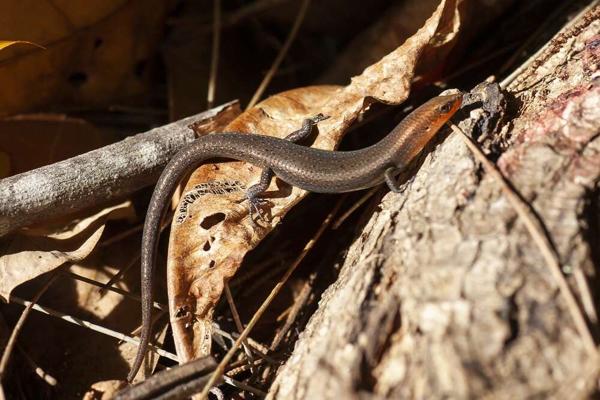

Sun-loving Litter Skink
Lygisaurus zuma
Silhouette: David Orr · PhyloPic
- KingdomAnimalia (Animals)
- PhylumChordata (Chordates)
- ClassSquamata
- FamilyScincidae (Skinks)
- GenusLygisaurus (Australasian Litter Skinks)
- SpeciesLygisaurus zuma (Sun-loving Litter Skink)
About the Sun-loving Litter Skink
Lygisaurus zuma, also known commonly as the sun-loving litter-skink, is a species of lizard in the subfamily Eugongylinae of the family Scincidae (skinks). The species is endemic to the Australian state of Queensland. The specific name, zuma, refers to Montezuma II, who was the last Aztec emperor and was also a sun worshipper.
Lygisaurus zuma has a large transparent disc in its moveable lower eyelid. The prominent ear-opening is round to almost horizontal, and edged with low flat lobules. There are seven upper labials. Adults have a snout-to-vent length (SVL) of about 3.4 cm (1.3 in).
Lygisaurus zuma is found in northeastern Queensland, in the vicinity of Mackay and in the vicinity of Townsville. The preferred natural habitat of Lygisaurus zuma is forest. Lygisaurus zuma is terrestrial. Lygisaurus zuma is oviparous. During the breeding season, a sexually mature male will develop a red throat and a red tail.
Cogger, H.G. (2014). Reptiles and Amphibians of Australia, Seventh Edition. Clayton, Victoria, Australia: CSIRO Publishing. ISBN... Wikipedia →
Recent sightings of Sun-loving Litter Skink in Daintree National Park
LIVEiNaturalistClosest Relatives at Daintree National Park

 Closed-litter Rainbow Skink
Carlia longipes
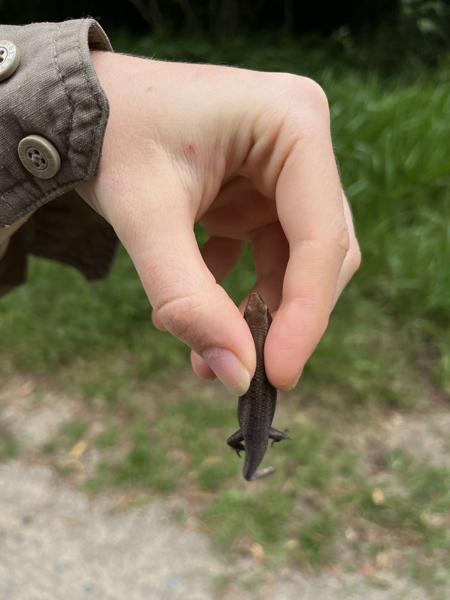
Northern Red-throated Rainbow Skink
Carlia crypta

Major Skink
Bellatorias frerei

Rainforest Water-skink
Concinnia tigrina

Prickly Forest Skink
Gnypetoscincus queenslandiae

Pale-lipped Shadeskink
Saproscincus basiliscus

Cream-striped Shining-skink
Cryptoblepharus virgatus
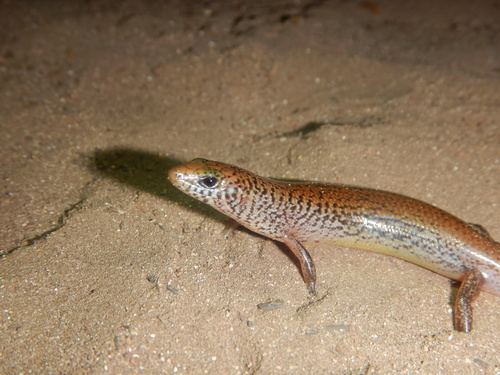
Black-tailed Bar-lipped Skink
Glaphyromorphus nigricaudis

Coastal Snake-eyed Skink
Cryptoblepharus litoralis

Lewis' Shadeskink
Saproscincus lewisi

Common Bluetongue
Tiliqua scincoides

Four-fingered Shadeskink
Saproscincus tetradactylus
Global Distribution
Warmer areas are where this animal is recorded most often.
Parks Where Found
| # | Park | Country | Daily sighting probability |
|---|---|---|---|
| 1 | Daintree National Park | 🇦🇺 Australia |
More parks will be added in future updates.