
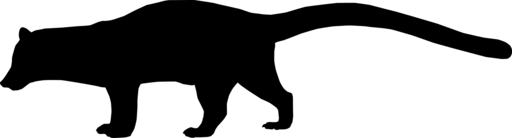
Brown Palm Civet
Paradoxurus jerdoni
Silhouette: Margot Michaud · PhyloPic
- KingdomAnimalia (Animals)
- PhylumChordata (Chordates)
- ClassMammalia (Mammals)
- OrderCarnivora (Carnivorans)
- FamilyViverridae (Civets, Genets, and Oyans)
- GenusParadoxurus (Common Palm Civets)
- SpeciesParadoxurus jerdoni (Brown Palm Civet)
About the Brown Palm Civet
The brown palm civet (Paradoxurus jerdoni), also called the Jerdon's palm civet, is a viverrid endemic to the Western Ghats of India. The scientific name Paradoxurus jerdoni was introduced by William Thomas Blanford in 1885 who described a skull and pelt of a brown palm civet collected in Kodaikanal. Blanford noted the long foramen on the anterior palate and also that the pelt matched another zoological specimen collected by Francis Day. Blanford named the species in honour of Thomas C. Jerdon. The subspecies caniscus was described by Reginald Innes Pocock on the basis of a specimen collected at Virajpet in southern Coorg.
There are two subspecies, the nominate P. j. jerdoni and P. j. caniscus. The brown palm civet has a uniformly brown pelage, darker around the head, neck, shoulder, legs, and tail. Sometimes the pelage may be slightly grizzled. Two subspecies have been described on the basis of the colour of the pelage although the colour is extremely variable, ranging from pale buff or light brown to dark brown. The dark tail sometimes has a white or pale-yellow tip. It has no distinct markings on the body or the face as in the Asian palm civet... Wikipedia →
Recent sightings of Brown Palm Civet in Eravikulam National Park
LIVEiNaturalistClosest Relatives at Eravikulam National Park


Global Distribution
Warmer areas are where this animal is recorded most often.
Parks Where Found
| # | Park | Country | Daily sighting probability |
|---|---|---|---|
| 1 | Eravikulam National Park | 🇮🇳 India |
More parks will be added in future updates.