


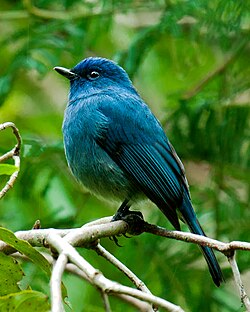
Nilgiri Flycatcher
Eumyias albicaudatus
Silhouette: Martin Bulla, based on François Desbordes' illustration · PhyloPic
- KingdomAnimalia (Animals)
- PhylumChordata (Chordates)
- ClassAves (Birds)
- OrderPasseriformes (Perching Birds)
- FamilyMuscicapidae (Old World Flycatchers, Robins, and Chats)
- GenusEumyias (Warbling Flycatchers)
- SpeciesEumyias albicaudatus (Nilgiri Flycatcher)
About the Nilgiri Flycatcher
The Nilgiri flycatcher (Eumyias albicaudatus) is an Old World flycatcher with a very restricted range in the hills of southern India. It was formerly referred to as the Nilgiri verditer flycatcher because of its similarity to the verditer flycatcher, a winter migrant to the Nilgiris, which, however, has distinct dark lores and a lighter shade of blue. There are two small white patches at the base of the tail. It is found mainly in the higher altitude shola forests of the Western Ghats and the Nilgiris.
This small and somewhat long-tailed flycatcher is about 13 cm (5.1 in). It is dark steely indigo blue with some violet-blue on the forehead and darker lores. It is much darker than the verditer flycatcher and does not have as strong a contrast in the pale face and black lores. The female is duller with dark brown on the upperparts and dark grey below. The two central tail feathers are blue and the lateral feathers are dark brown and edged with indigo. The bases of the outer tail feathers are white but this is not easily visible when the bird is sitting. The wing feathers are dark brown with a narrow outer fringe of blue. The juvenile is dark brown with creamy spots... Wikipedia →
Recent sightings of Nilgiri Flycatcher in Eravikulam National Park
LIVEiNaturalistClosest Relatives at Eravikulam National Park

 Verditer Flycatcher
Eumyias thalassinus

Oriental Magpie-Robin
Copsychus saularis

Malabar Whistling-Thrush
Myophonus horsfieldii

 Pied Bushchat
Saxicola caprata

White-bellied Blue Robin
Myiomela albiventris

 Black-and-orange Flycatcher
Ficedula nigrorufa

Blue Rock-Thrush
Monticola solitarius

 Indian Blue Robin
Luscinia brunnea

 Rusty-tailed Flycatcher
Muscicapa ruficauda

Blue-capped Rock-Thrush
Monticola cinclorhynchus

Asian Brown Flycatcher
Muscicapa latirostris

 Tickell's Blue Flycatcher
Cyornis tickelliae
Global Distribution
Warmer areas are where this animal is recorded most often.
Parks Where Found
| # | Park | Country | Daily sighting probability |
|---|---|---|---|
| 1 | Eravikulam National Park | 🇮🇳 India | |
| 2 | Mudumalai National Park | 🇮🇳 India | |
| 3 | Bandipur National Park | 🇮🇳 India |
Quick answers
What are the chances of seeing a Nilgiri Flycatcher in Eravikulam National Park?
About 40% of wildlife watchers report a Nilgiri Flycatcher sighting in Eravikulam National Park, based on 63 verified sightings from GBIF citizen-science data.
When is the best time to see Nilgiri Flycatcher in Eravikulam National Park?
March has the highest sighting rate for Nilgiri Flycatcher in Eravikulam National Park in our monthly data.