
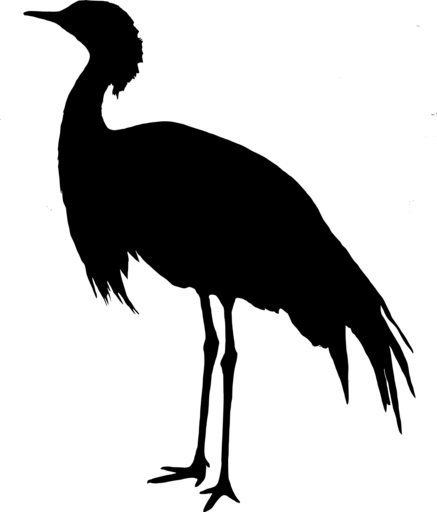
Demoiselle Crane
Anthropoides virgo
Silhouette: Kai Caspar · PhyloPic
- KingdomAnimalia (Animals)
- PhylumChordata (Chordates)
- ClassAves (Birds)
- OrderGruiformes (Cranes, Rails, and Allies)
- FamilyGruidae (Cranes)
- GenusAnthropoides
- SpeciesAnthropoides virgo (Demoiselle Crane)
About the Demoiselle Crane
The demoiselle crane (Grus virgo) is a species of crane found in central Eurosiberia, ranging from the Black Sea to Mongolia and Northeast China. There is also a small breeding population in Turkey. These cranes are migratory birds. Birds from western Eurasia will spend the winter in Africa while the birds from Asia, Mongolia and China will spend the winter in the Indian subcontinent. The bird is symbolically significant in the culture of India, where it is known as koonj or kurjaa.
The demoiselle crane was formally described in 1758 by the Swedish naturalist Carl Linnaeus in the tenth edition of his Systema Naturae. He placed it with the herons and cranes in the genus Ardea and coined the binomial name Ardea virgo. He specified the type locality as the orient but this has been restricted to India. Linnaeus cited the accounts by earlier authors. The English naturalist Eleazar Albin had described and illustrated the "Numidian crane" in 1738. Albin explained that: "This Bird is called Demoiselles by reason of certain ways of acting that it has, wherein it seems to imitate the Gestures of a Woman who affects a Grace in her Walking, Obeisances, and Dancing". Linnaeus also... Wikipedia →
Recent sightings of Demoiselle Crane in Fertő-Hanság National Park
LIVEiNaturalist


Global Distribution
Warmer areas are where this animal is recorded most often.
Parks Where Found
| # | Park | Country | Daily sighting probability |
|---|---|---|---|
| 1 | Gobi Gurvansaikhan National Park | 🇲🇳 Mongolia | |
| 2 | Keoladeo National Park | 🇮🇳 India | |
| 3 | Ranthambore National Park | 🇮🇳 India | |
| 4 | Kiskunság National Park | 🇭🇺 Hungary | |
| 5 | Fertő-Hanság National Park | 🇭🇺 Hungary |