


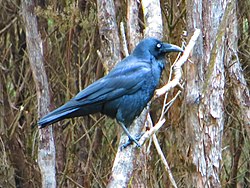

Forest Raven
Corvus tasmanicus
Silhouette: Kawinwit Kittipalawattanapol · PhyloPic
- KingdomAnimalia (Animals)
- PhylumChordata (Chordates)
- ClassAves (Birds)
- OrderPasseriformes (Perching Birds)
- FamilyCorvidae (Crows, Jays, and Magpies)
- GenusCorvus (Crows and Ravens)
- SpeciesCorvus tasmanicus (Forest Raven)
About the Forest Raven
The forest raven (Corvus tasmanicus), also commonly known as the Tasmanian raven, is a passerine bird in the family Corvidae native to Tasmania and parts of southern Victoria, such as Wilsons Promontory and Portland. Populations are also found in parts of New South Wales, including Dorrigo and Armidale. Measuring 50–53 cm (20–21 in) in length, it has all-black plumage, beak and legs. As with the other two species of raven in Australia, its black feathers have grey bases. Adults have white irises; younger birds have dark brown and then hazel irises with an inner blue rim. New South Wales populations are recognised as a separate subspecies C. tasmanicus boreus, but appear to be nested within the Tasmanian subspecies genetically.
The forest raven lives in a wide variety of habitats in Tasmania but is restricted to more closed forest on mainland Australia. Breeding takes place in spring and summer, occurring later in Tasmania than in New South Wales. The nest is a bowl-shaped structure of sticks sited high in a tree. An omnivorous and opportunistic feeder, the forest raven eats a wide variety of plant and animal material, as well as food waste from urban areas and roadkill. It has been blamed for killing lambs and poultry and raiding orchards in Tasmania, and is unprotected under Tasmanian legislation. The forest raven is sedentary, with pairs generally bonding for life and establishing permanent territories. Wikipedia →
Recent sightings of Forest Raven in Freycinet National Park
LIVEiNaturalistClosest Relatives at Freycinet National Park

 Superb Fairywren
Malurus cyaneus

 Grey Fantail
Rhipidura albiscapa

 Yellow Wattlebird
Anthochaera paradoxa

 Brown Thornbill
Acanthiza pusilla

Little Wattlebird
Anthochaera chrysoptera

 New Holland Honeyeater
Phylidonyris novaehollandiae

 Tasmanian Scrubwren
Sericornis humilis

 Silvereye
Zosterops lateralis

 Eastern Spinebill
Acanthorhynchus tenuirostris

Yellow-throated Honeyeater
Nesoptilotis flavicollis

Gray Shrikethrush
Colluricincla harmonica

Scarlet Robin
Petroica boodang
Global Distribution
Warmer areas are where this animal is recorded most often.
Parks Where Found
| # | Park | Country | Daily sighting probability |
|---|---|---|---|
| 1 | Maria Island National Park | 🇦🇺 Australia | |
| 2 | Freycinet National Park | 🇦🇺 Australia | |
| 3 | Cradle Mountain-Lake St Clair National Park | 🇦🇺 Australia | |
| 4 | Wilsons Promontory National Park | 🇦🇺 Australia | |
| 5 | Great Otway National Park | 🇦🇺 Australia | |
| 6 | Grampians National Park | 🇦🇺 Australia |
Quick answers
What are the chances of seeing a Forest Raven in Freycinet National Park?
About 60% of wildlife watchers report a Forest Raven sighting in Freycinet National Park, based on 162 verified sightings from GBIF citizen-science data.
When is the best time to see Forest Raven in Freycinet National Park?
May has the highest sighting rate for Forest Raven in Freycinet National Park in our monthly data.