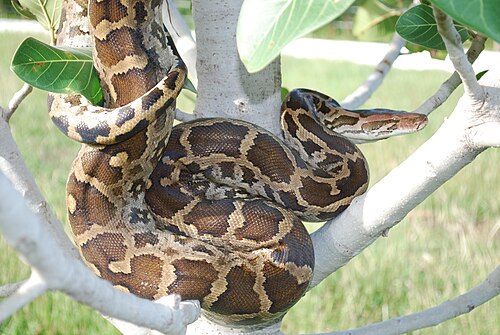


Indian Python
Python molurus
- KingdomAnimalia (Animals)
- PhylumChordata (Chordates)
- ClassSquamata
- FamilyPythonidae (Pythons)
- GenusPython (Common Pythons)
- SpeciesPython molurus (Indian Python)
About the Indian Python
The Indian python (Python molurus) is a large python species native to tropical and subtropical regions of the Indian subcontinent and Southeast Asia. It is also known by the common names black-tailed python, Indian rock python, and Asian rock python. Although smaller than its close relative the Burmese python, it is still among the largest snakes in the world. It is generally lighter colored than the Burmese python and reaches usually 3 m (9 ft 10 in). Like all pythons, it is nonvenomous.
The rock python's color pattern is whitish or yellowish with the blotched patterns varying from tan to dark brown shades. This varies with terrain and habitat. Specimens from the hill forests of Western Ghats and Assam are darker, while those from the Deccan Plateau and Eastern Ghats are usually lighter. All pythons are non-venomous.
The nominate subspecies occurring in India typically grows to 3 m (9 ft 10 in). This value is supported by a 1990 study in Keoladeo National Park, where 25% of the python population was 2.7–3.3 m (8 ft 10 in – 10 ft 10 in) long. Two individuals even measured nearly 3.6 m (11 ft 10 in).
Because of confusion with the Burmese python, exaggerations, and... Wikipedia →
Global Distribution
Where this species is recorded worldwide. Restricted to human observations from 2019 onwards — the same kind of record and the same period the probabilities on this page are built from, so collar-tracking studies, camera-trap arrays and museum specimens are excluded. Around Santa Rosa that removes 5,924 GPS fixes from a handful of tagged jaguars.
where this species is recorded (GBIF density — it tracks where observers go, not how likely a sighting is) · parks where it occurs — tap a pin for the sighting probability there
Parks Where Found
| # | Park | Country | Daily sighting probability |
|---|---|---|---|
| 1 | Keoladeo National Park | 🇮🇳 India | |
| 2 | Kanha National Park | 🇮🇳 India | |
| 3 | Yala National Park | 🇱🇰 Sri Lanka | |
| 4 | Gir National Park | 🇮🇳 India | |
| 5 | Nagarhole National Park | 🇮🇳 India | |
| 6 | Wilpattu National Park | 🇱🇰 Sri Lanka | |
| 7 | Sinharaja Forest Reserve | 🇱🇰 Sri Lanka | |
| 8 | Bandipur National Park | 🇮🇳 India |