



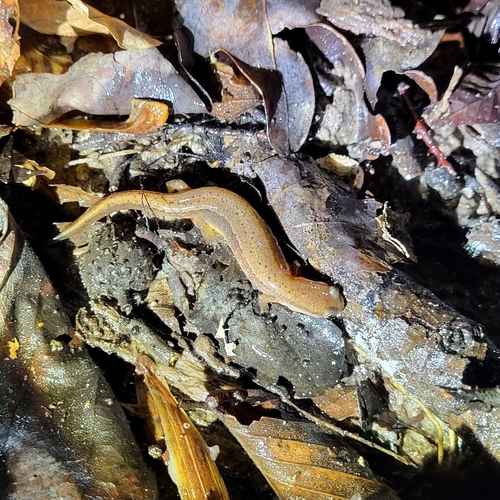
Blue Ridge Two-lined Salamander
Eurycea wilderae
Silhouette: Andy Wilson · PhyloPic
- KingdomAnimalia (Animals)
- PhylumChordata (Chordates)
- ClassAmphibia (Amphibians)
- OrderCaudata (Salamanders)
- FamilyPlethodontidae (Lungless Salamanders)
- GenusEurycea (Brook Salamanders)
- SpeciesEurycea wilderae (Blue Ridge Two-lined Salamander)
About the Blue Ridge Two-lined Salamander
The Blue Ridge two-lined salamander (Eurycea wilderae) is a species of salamander in the family Plethodontidae, endemic to the United States. This species is found in the southern Appalachian Mountains, mostly south of Virginia. To the north is a similar salamander, Eurycea bislineata, or the northern two-lined salamander. Its genus, Eurycea contains 33 species and includes taxa that have either a metamorphic life cycle or larval-form paedomorphosis. In species that metamorphose, there can be within-and among-population variation in larval life-history characteristics, e.g., duration of the larval period and size at metamorphosis. Intraspecific geographic variation in species of Eurycea has been attributed to several factors: temperature, stream order and productivity of the larval habitat.
Adult Blue Ridge two-lined salamanders are commonly found near stream banks. The larvae are aquatic, living in streams and seeps. Its natural habitats are temperate forests, rivers, intermittent rivers, and freshwater springs. It is threatened by habitat loss. This species is named after zoologist Inez Whipple Wilder, who studied biology of Eurycea species.
These amphibians are listed by the IUCN as a species of least concern for conservation. Wikipedia →
Recent sightings of Blue Ridge Two-lined Salamander in Great Smoky Mountains National Park
LIVEiNaturalistClosest Relatives at Great Smoky Mountains National Park

 Long-tailed Salamander
Eurycea longicauda

 Three-lined Salamander
Eurycea guttolineata

Cave Salamander
Eurycea lucifuga

Junaluska Salamander
Eurycea junaluska

Southern Two-lined Salamander
Eurycea cirrigera
Brownback Salamander
Eurycea aquatica

 Red-cheeked Salamander
Plethodon jordani

 Spring Salamander
Gyrinophilus porphyriticus

 Seal Salamander
Desmognathus monticola

Imitator Salamander
Desmognathus imitator

Southern Red-backed Salamander
Plethodon serratus

 Red Salamander
Pseudotriton ruber
Global Distribution
Warmer areas are where this animal is recorded most often.
Parks Where Found
| # | Park | Country | Daily sighting probability |
|---|---|---|---|
| 1 | Great Smoky Mountains National Park | 🇺🇸 United States |
More parks will be added in future updates.
Quick answers
What are the chances of seeing a Blue Ridge Two-lined Salamander in Great Smoky Mountains National Park?
About 50% of wildlife watchers report a Blue Ridge Two-lined Salamander sighting in Great Smoky Mountains National Park, based on 646 verified sightings from GBIF citizen-science data.
When is the best time to see Blue Ridge Two-lined Salamander in Great Smoky Mountains National Park?
March has the highest sighting rate for Blue Ridge Two-lined Salamander in Great Smoky Mountains National Park in our monthly data.