


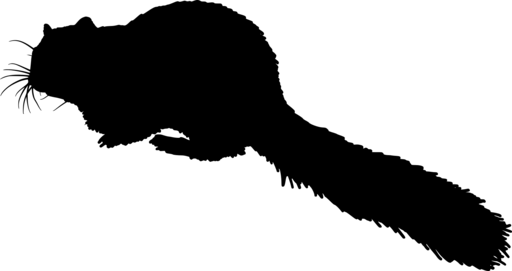
Fox Squirrel
Sciurus niger
Silhouette: Andy Wilson · PhyloPic
- KingdomAnimalia (Animals)
- PhylumChordata (Chordates)
- ClassMammalia (Mammals)
- OrderRodentia (Rodents)
- FamilySciuridae (Squirrels)
- GenusSciurus (Tree Squirrels)
- SpeciesSciurus niger (Fox Squirrel)
About the Fox Squirrel
The fox squirrel (Sciurus niger), also known as the eastern fox squirrel or Bryant's fox squirrel, is the largest species of tree squirrel native to North America. It is sometimes mistaken for the American red squirrel or eastern gray squirrel in areas where the species coexist, though they differ in size and coloration.The word Sciurus came from the ancient Greek words skia, meaning shade, and oura, meaning tail. Niger refers to the black coloration.
The fox squirrel's total length measures 20 to 30 in (50.8 to 76.2 cm), with a body length of 10 to 15 in (25.4 to 38.1 cm) and a similar tail length. They range in weight from 1.0 to 2.5 lb (453.6 to 1,134.0 g).The length of its hind foot is 5.1 to 8.2 cm. There is no sexual dimorphism in size or appearance. Individuals tend to be smaller in the West. There are three distinct geographical morphs in coloration. In most areas, the animal's upper body is brown-grey to brown-yellow with a typically brownish-orange underside, while in eastern regions, such as the Appalachians, there are more strikingly-patterned dark brown and black squirrels with white bands on the face and tail. In the South and parts of Nebraska and Iowa... Wikipedia →
Recent sightings of Fox Squirrel in Great Smoky Mountains National Park
LIVEiNaturalistClosest Relatives at Great Smoky Mountains National Park

 Eastern Gray Squirrel
Sciurus carolinensis

 American Red Squirrel
Tamiasciurus hudsonicus

 Woodchuck
Marmota monax

 Eastern Chipmunk
Tamias striatus

 Southern Flying Squirrel
Glaucomys volans

Northern Flying Squirrel
Glaucomys sabrinus

 American Beaver
Castor canadensis

 Muskrat
Ondatra zibethicus

 Hispid Cotton Rat
Sigmodon hispidus

 White-footed Mouse
Peromyscus leucopus

 Eastern Woodrat
Neotoma floridana

 Southern Red-backed Vole
Myodes gapperi
Global Distribution
Warmer areas are where this animal is recorded most often.
Parks Where Found
| # | Park | Country | Daily sighting probability |
|---|---|---|---|
| 1 | Big Cypress National Preserve | 🇺🇸 United States | |
| 2 | Congaree National Park | 🇺🇸 United States | |
| 3 | Point Pelee National Park | 🇨🇦 Canada | |
| 4 | Everglades National Park | 🇺🇸 United States | |
| 5 | Shenandoah National Park | 🇺🇸 United States | |
| 6 | Joshua Tree National Park | 🇺🇸 United States |