


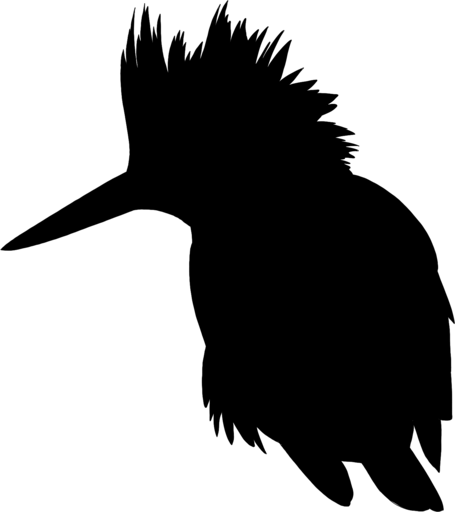
Crested Kingfisher
Megaceryle lugubris
Silhouette: Andy Wilson · PhyloPic
- KingdomAnimalia (Animals)
- PhylumChordata (Chordates)
- ClassAves (Birds)
- OrderCoraciiformes (Rollers, Kingfishers, and Allies)
- FamilyAlcedinidae (Kingfishers)
- GenusMegaceryle (Large Crested Kingfishers)
- SpeciesMegaceryle lugubris (Crested Kingfisher)
About the Crested Kingfisher
The crested kingfisher (Megaceryle lugubris) is a very large kingfisher that is native to parts of southern Asia. It is part of the kingfisher genus Megaceryle with three other species: the giant kingfisher (Megaceryle maxima), the ringed kingfisher (Megaceryle torquata), and the belted kingfisher (Megaceryle alcyon) with which it forms a species complex.
The crested kingfisher is a very large, stocky black and white bird, usually between 38 and 43 cm (15 and 17 in) tall, and weighs between 230 and 280 g (8 and 10 oz). It has a large, pointed black bill with a yellowish-white tip and a large, shaggy black and white barred crest. It has finely barred black and white upperparts with flanks barred grey and white, while its belly is white with a black-speckled breastband. It has a white collar that starts at the bottom of the bill and goes to the back of the neck. The tail feathers are black with 6 to 8 white bars. Males and females are the same size but exhibit sexual dimorphism in their plumage. Females have bright pink-cinnamon underwing coverts washed with pale rufous, while males lack this and instead have rufus-orange feathers on the breastband.
The... Wikipedia →
Recent sightings of Crested Kingfisher in Jim Corbett National Park
LIVEiNaturalistClosest Relatives at Jim Corbett National Park

 White-throated Kingfisher
Halcyon smyrnensis

 Common Kingfisher
Alcedo atthis

Stork-billed Kingfisher
Pelargopsis capensis

Pied Kingfisher
Ceryle rudis

 Asian Green Bee-eater
Merops orientalis

Chestnut-headed Bee-eater
Merops leschenaulti

Blue-bearded Bee-eater
Nyctyornis athertoni

Blue-tailed Bee-eater
Merops philippinus

 Dollarbird
Eurystomus orientalis

Indian Roller
Coracias benghalensis
Global Distribution
Warmer areas are where this animal is recorded most often.
Parks Where Found
| # | Park | Country | Daily sighting probability |
|---|---|---|---|
| 1 | Jim Corbett National Park | 🇮🇳 India | |
| 2 | Namdapha National Park | 🇮🇳 India | |
| 3 | Royal Manas National Park | 🇧🇹 Bhutan | |
| 4 | Manas National Park | 🇮🇳 India | |
| 5 | Chitwan National Park | 🇳🇵 Nepal | |
| 6 | Royal Bardia National Park | 🇳🇵 Nepal | |
| 7 | Nikko National Park | 🇯🇵 Japan |
Quick answers
What are the chances of seeing a Crested Kingfisher in Jim Corbett National Park?
About 30% of wildlife watchers report a Crested Kingfisher sighting in Jim Corbett National Park, based on 570 verified sightings from GBIF citizen-science data.
When is the best time to see Crested Kingfisher in Jim Corbett National Park?
December has the highest sighting rate for Crested Kingfisher in Jim Corbett National Park in our monthly data.