
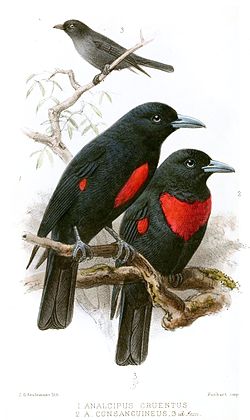

Black-and-crimson Oriole (Javan)
Oriolus cruentus
Silhouette: L. Shyamal · PhyloPic
- KingdomAnimalia (Animals)
- PhylumChordata (Chordates)
- ClassAves (Birds)
- OrderPasseriformes (Perching Birds)
- FamilyOriolidae (Old World Orioles)
- GenusOriolus (Old World Orioles)
- SpeciesOriolus cruentus (Black-and-crimson Oriole (Javan))
About the Black-and-crimson Oriole (Javan)
The Javan oriole (Oriolus cruentus) is a species of bird in the family Oriolidae. It is found on Java in Indonesia where its natural habitats are subtropical or tropical moist lowland forest and subtropical or tropical moist montane forest.
Temuan people believe that its song brings bad luck. Wikipedia →
Recent sightings of Black-and-crimson Oriole (Javan) in Kerinci Seblat National Park
LIVEiNaturalistClosest Relatives at Kerinci Seblat National Park

 Dark-throated Oriole
Oriolus xanthonotus

Black-naped Oriole
Oriolus chinensis

 Grey-headed Canary-Flycatcher
Culicicapa ceylonensis

Gray-throated Babbler
Stachyris nigriceps

 White-throated Fantail
Rhipidura albicollis

Sumatran Treepie
Dendrocitta occipitalis

 Ashy Drongo
Dicrurus leucophaeus

 Shiny Whistling-Thrush
Myophonus melanurus

 Sunda Warbler
Seicercus grammiceps

 Snowy-browed Flycatcher
Ficedula hyperythra

 Long-tailed Shrike
Lanius schach

 Temminck's Sunbird
Aethopyga temminckii
Global Distribution
Warmer areas are where this animal is recorded most often.
Parks Where Found
| # | Park | Country | Daily sighting probability |
|---|---|---|---|
| 1 | Kerinci Seblat National Park | 🇮🇩 Indonesia | |
| 2 | Kinabalu Park | 🇲🇾 Malaysia | |
| 3 | Tanjung Puting National Park | 🇮🇩 Indonesia | |
| 4 | Taman Negara National Park | 🇲🇾 Malaysia | |
| 5 | Sepilok | 🇲🇾 Malaysia |
Quick answers
What are the chances of seeing a Black-and-crimson Oriole (Javan) in Kerinci Seblat National Park?
About 40% of wildlife watchers report a Black-and-crimson Oriole (Javan) sighting in Kerinci Seblat National Park, based on 294 verified sightings from GBIF citizen-science data.
When is the best time to see Black-and-crimson Oriole (Javan) in Kerinci Seblat National Park?
August has the highest sighting rate for Black-and-crimson Oriole (Javan) in Kerinci Seblat National Park in our monthly data.