

Green-spectacled Green-Pigeon
Treron oxyurus
Silhouette: Sheatherius · PhyloPic
- KingdomAnimalia (Animals)
- PhylumChordata (Chordates)
- ClassAves (Birds)
- OrderColumbiformes (Pigeons and Doves)
- FamilyColumbidae (Pigeons and Doves)
- GenusTreron (Green-Pigeons)
- SpeciesTreron oxyurus (Green-spectacled Green-Pigeon)
About the Green-spectacled Green-Pigeon
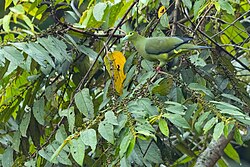
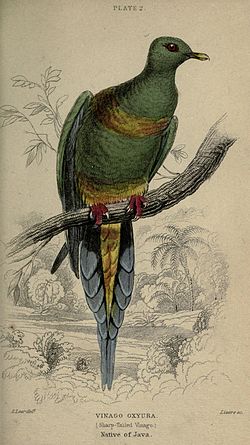
The Sumatran green pigeon (Treron oxyurus) is a species of bird in the pigeon family, Columbidae. First described by the Dutch zoologist Coenraad Jacob Temminck in 1823, it is endemic to Indonesia, where it is found in Sumatra and western Java. It inhabits the canopy of dense hill and montane forest and has been recorded at elevations of 350 to 1,800 m (1,100 to 5,900 ft) on Sumatra and 600 to 3,000 m (2,000 to 9,800 ft) on Java. The Sumatran green pigeon is a relatively slender species with a long wedge-shaped tail and an adult length of 29.0–34.1 cm (11.4–13.4 in) in males and 27.7–29.0 cm (10.9–11.4 in) in females. Adult males have a dark green head and body, bright yellow lower belly and undertail-coverts, dark grey tail, and bluish-green unfeathered patches on the face. Adult females are duller and have no grey on the back of the neck, a fainter orange wash on the breast, and no orange markings on the crown or the bend of the wing.
The species feeds on fruit such as figs, leaving overnight roosts of up to 50 birds to feed in the early morning and returning in the late afternoon. Breeding has been observed in January and September on Sumatra and in June on Java. Nests are built in trees and contain one or two eggs incubated by both parents. The Sumatran green pigeon is listed as near-threatened on the IUCN Red List due to a "moderately small" population that is continuing to decline because of habitat degradation. It was previously considered to be locally common throughout its range, but is now scarce on Sumatra and very rare on Java. It is threatened by habitat loss and the wildlife trade. Wikipedia →
Recent sightings of Green-spectacled Green-Pigeon in Kerinci Seblat National Park
LIVEiNaturalistClosest Relatives at Kerinci Seblat National Park

 Wedge-tailed Green-Pigeon
Treron sphenurus

Pink-necked Green-Pigeon
Treron vernans

Little Green-Pigeon
Treron olax

Little Cuckoo-Dove
Macropygia ruficeps

 Pearl-necked Dove
Spilopelia chinensis

Barred Cuckoo-Dove
Macropygia unchall

Asian Emerald Dove
Chalcophaps indica

Zebra Dove
Geopelia striata

 Pink-headed Fruit-Dove
Ptilinopus porphyreus

Mountain Imperial-Pigeon
Ducula badia

Green Imperial-Pigeon
Ducula aenea

Jambu Fruit-Dove
Ptilinopus jambu
Global Distribution
Warmer areas are where this animal is recorded most often.
Parks Where Found
| # | Park | Country | Daily sighting probability |
|---|---|---|---|
| 1 | Kerinci Seblat National Park | 🇮🇩 Indonesia |
More parks will be added in future updates.
Quick answers
What are the chances of seeing a Green-spectacled Green-Pigeon in Kerinci Seblat National Park?
About 30% of wildlife watchers report a Green-spectacled Green-Pigeon sighting in Kerinci Seblat National Park, based on 194 verified sightings from GBIF citizen-science data.
When is the best time to see Green-spectacled Green-Pigeon in Kerinci Seblat National Park?
September has the highest sighting rate for Green-spectacled Green-Pigeon in Kerinci Seblat National Park in our monthly data.