



Crimson-headed Partridge
Haematortyx sanguiniceps
Silhouette: Sheatherius · PhyloPic
- KingdomAnimalia (Animals)
- PhylumChordata (Chordates)
- ClassAves (Birds)
- OrderGalliformes (Landfowl)
- FamilyPhasianidae (Pheasants, Grouse, and Allies)
- GenusHaematortyx
- SpeciesHaematortyx sanguiniceps (Crimson-headed Partridge)
About the Crimson-headed Partridge
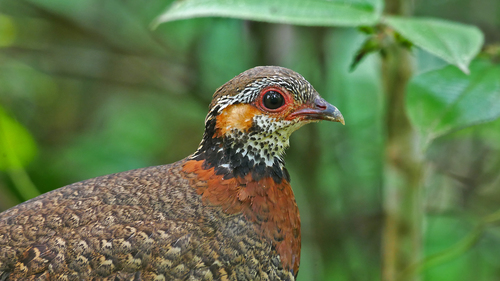
The crimson-headed partridge (Haematortyx sanguiniceps) is a species of bird in the pheasant, partridge, and francolin family Phasianidae. Described by the British ornithologist Richard Bowdler Sharpe in 1879, it is the only species in the genus Haematortyx. It is endemic to Borneo, where it inhabits lower montane forest in the northern and central parts of the island. It is mainly found at elevations of 1,000–1,700 m (3,300–5,600 ft), but can be seen as low as 185 m (607 ft) and as high as 3,050 m (10,010 ft). Adult males have a striking appearance, with a dark blackish body and crimson red heads, necks, breasts, and undertail coverts. Females have a similar pattern, but with duller brownish-black colouration, orangish-red heads and breasts, and a brownish-black bill instead of a yellowish one. Juveniles are duller and have the crimson restricted to the top of the head.
The species feeds on berries, insects, and small crustaceans. Nests of dry leaves are built in tussocks of grass or lichen, with eggs being laid from mid-January onwards. Clutches have 8–9 eggs and incubation takes 18–19 days in captivity. The crimson-headed partridge is classified as being of least concern by the International Union for Conservation of Nature due to its fairly large range, sufficiently large population, and a lack of significant population decline. It has a population of 1,000–10,000 total individuals and 670–6,700 mature birds which is thought to be declining. Wikipedia →
Recent sightings of Crimson-headed Partridge in Kinabalu Park
LIVEiNaturalistClosest Relatives at Kinabalu Park

 Red-breasted Hill Partridge
Arborophila hyperythra

 Great Argus
Argusianus argus
 Chestnut-necklaced Hill Partridge
Tropicoperdix charltonii

 Red Junglefowl
Gallus gallus

Bornean Crested Fireback
Lophura ignita

 Roulroul
Rollulus rouloul

Bulwer's Pheasant
Lophura bulweri

 Asian Blue Quail
Synoicus chinensis
Global Distribution
Warmer areas are where this animal is recorded most often.
Parks Where Found
| # | Park | Country | Daily sighting probability |
|---|---|---|---|
| 1 | Kinabalu Park | 🇲🇾 Malaysia | |
| 2 | Kinabatangan Wildlife Sanctuary | 🇲🇾 Malaysia |
Quick answers
What are the chances of seeing a Crimson-headed Partridge in Kinabalu Park?
About 40% of wildlife watchers report a Crimson-headed Partridge sighting in Kinabalu Park, based on 1,200 verified sightings from GBIF citizen-science data.
When is the best time to see Crimson-headed Partridge in Kinabalu Park?
March has the highest sighting rate for Crimson-headed Partridge in Kinabalu Park in our monthly data.