


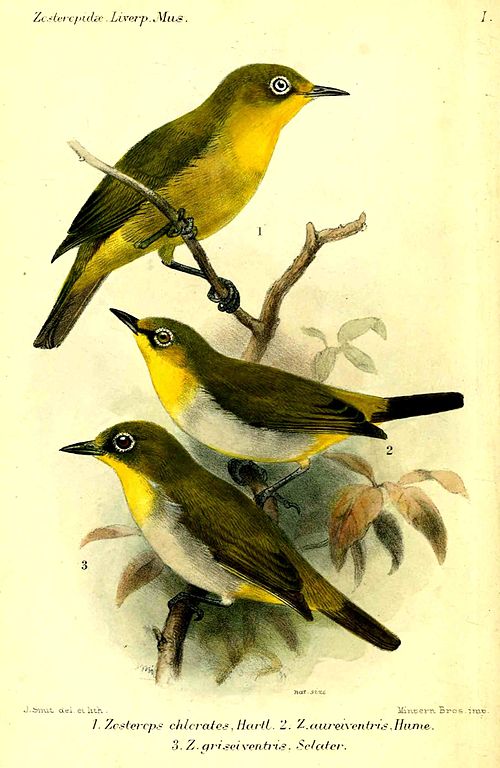
Yellow-bellied White-eye
Zosterops chloris
- KingdomAnimalia (Animals)
- PhylumChordata (Chordates)
- ClassAves (Birds)
- OrderPasseriformes (Perching Birds)
- FamilyZosteropidae (White-eyes, Yuhinas, and Allies)
- GenusZosterops (Typical White-eyes)
- SpeciesZosterops chloris (Yellow-bellied White-eye)
About the Yellow-bellied White-eye
The lemon-bellied white-eye (Zosterops chloris) is a species of bird in the family Zosteropidae. It is endemic to Indonesia, where it occurs on a number of islands from the Sunda Strait to the Aru Islands. It is present on several of the Lesser Sunda Islands as well as on parts of Sulawesi, as well as many smaller islands, but is absent from the larger islands of Borneo, Java, Sumatra and Timor. Currently (May 2017), HBW describes five sub-species of lemon-bellied white-eye. However, the extensive distribution of Z. c. intermedius (including S. Sulawesi, SE. Sulawesi, C. Lesser Sundas and small islands in between) is likely to contain more than one reproductively isolated population (cf. Z.c. intermedius and Z. c. flavissimus, with the latter now considered a distinct species, the Wakatobi white-eye (Z. flavissimus).
The lemon-bellied white-eye's natural habitats are subtropical or tropical moist lowland forests and subtropical or tropical mangrove forests. On the islands of Buton and Kabaena the lemon-bellied white-eye appears limited to coastal regions, perhaps as a result of competition with the pale-bellied white-eye. Observations from Buton suggest that the lemon-bellied white-eye prefers more disturbed habitats. Their diet consists of invertebrates, fruits, and nectar. They have strong dark grey legs, a dark colored beak, and generally range in size from 11 to 12 cm. They are a yellow-olive color on the dorsal side, with characteristic bright yellow underparts. Wikipedia →
Closest Relatives at Komodo National Park

Yellow-spectacled Heleia
Zosterops wallacei

Ashy-bellied White-eye
Zosterops citrinella

Large-billed Crow
Corvus macrorhynchos

Black-naped Oriole
Oriolus chinensis

Pacific Swallow
Hirundo javanica

Helmeted Friarbird
Philemon buceroides

Eastern Red-rumped Swallow
Cecropis daurica

Flame-breasted Sunbird
Cinnyris solaris

Black-naped Monarch
Hypothymis azurea

Wallacean Drongo
Dicrurus densus
Artamus leucorhynchos
Artamus leucorhynchos

Pied Bushchat
Saxicola caprata
Global Distribution
Where this species is recorded worldwide. Restricted to human observations from 2019 onwards — the same kind of record and the same period the probabilities on this page are built from, so collar-tracking studies, camera-trap arrays and museum specimens are excluded. Around Santa Rosa that removes 5,924 GPS fixes from a handful of tagged jaguars.
where this species is recorded (GBIF density — it tracks where observers go, not how likely a sighting is) · parks where it occurs — tap a pin for the sighting probability there
Parks Where Found
| # | Park | Country | Daily sighting probability |
|---|---|---|---|
| 1 | Bali Barat National Park | 🇮🇩 Indonesia | |
| 2 | Raja Ampat | 🇮🇩 Indonesia |
Quick answers
What are the chances of seeing a Yellow-bellied White-eye in Komodo National Park?
About 30% of wildlife watchers report a Yellow-bellied White-eye sighting in Komodo National Park, based on 80 verified sightings from GBIF citizen-science data.
When is the best time to see Yellow-bellied White-eye in Komodo National Park?
September has the highest sighting rate for Yellow-bellied White-eye in Komodo National Park in our monthly data.