

Giant Lance Skink
Acontias plumbeus
Silhouette: David Orr · PhyloPic
- KingdomAnimalia (Animals)
- PhylumChordata (Chordates)
- ClassSquamata
- FamilyScincidae (Skinks)
- GenusAcontias
- SpeciesAcontias plumbeus (Giant Lance Skink)
About the Giant Lance Skink
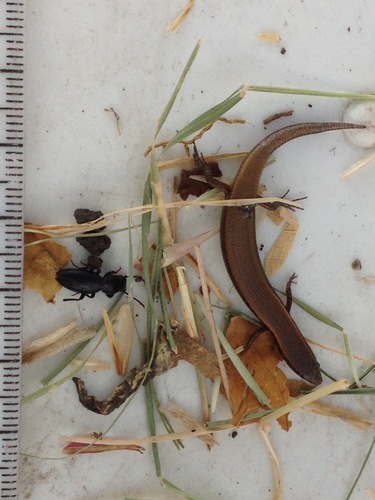
Acontias plumbeus, the giant legless skink or giant lance skink, is a species of lizard in the family Scincidae. It is found in South Africa, Eswatini, Mozambique, and Zimbabwe. Acontias plumbei live in seasonally dry savanna, woodland humus, and forest floor leaf litter throughout South Africa ranging from Eastern Cape to Zimbabwe.
It was previously believed that acontias plumbeus had no genetic variation and existed as a monotypic species, however the genetic structure analysis has revealed that acontias poecilus are morphological variations of acontias plumbeus. Its morphological variation now appends species of different colors including uniform light brown, dark brown, black, and intermediate gray. Wikipedia →
Recent sightings of Giant Lance Skink in Kruger National Park
LIVEiNaturalistClosest Relatives at Kruger National Park

 Okahandja Legless Skink
Acontias occidentalis

Rainbow Skink
Trachylepis margaritifera

African Striped Skink
Trachylepis striata

Damara Skink
Trachylepis damarana

Sundevall's Writhing Skink
Mochlus sundevallii

Variable Skink
Trachylepis varia

Wahlberg's Snake-eyed Skink
Panaspis wahlbergii
Spotted-neck Snake-eyed Skink
Panaspis maculicollis

Lowveld Dwarf Burrowing Skink
Scelotes bidigittatus

Eastern Sand Skink
Trachylepis depressa

Mozambique Dwarf Burrowing Skink
Scelotes mossambicus

Montane Burrowing Skink
Scelotes mirus
Global Distribution
Warmer areas are where this animal is recorded most often.
Parks Where Found
| # | Park | Country | Daily sighting probability |
|---|---|---|---|
| 1 | Hluhluwe-Imfolozi Park | 🇿🇦 South Africa | |
| 2 | iSimangaliso Wetland Park | 🇿🇦 South Africa | |
| 3 | Kruger National Park | 🇿🇦 South Africa |
Quick answers
What are the chances of seeing a Giant Lance Skink in Kruger National Park?
About 10% of wildlife watchers report a Giant Lance Skink sighting in Kruger National Park, based on 66 verified sightings from GBIF citizen-science data.
When is the best time to see Giant Lance Skink in Kruger National Park?
April has the highest sighting rate for Giant Lance Skink in Kruger National Park in our monthly data.