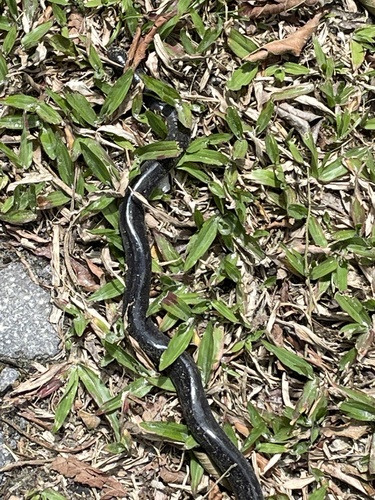

Cocle Caecilian
Caecilia volcani
Silhouette: PhyloPic · PhyloPic
- KingdomAnimalia (Animals)
- PhylumChordata (Chordates)
- ClassAmphibia (Amphibians)
- OrderGymnophiona (Caecilians)
- FamilyCaeciliidae (Common Caecilians)
- GenusCaecilia (Common Caecilians)
- SpeciesCaecilia volcani (Cocle Caecilian)
About the Cocle Caecilian
Caecilia volcani, known commonly as the Cocle Caecilian, is a species of caecilian in the family Caeciliidae. It is endemic to Central America, having only been found in Panama and Costa Rica. The first description of Caecilia volcani was published by Edward Harrison Taylor in 1969. The holotype, a female, was collected by Taylor and his field partner Charles Myers in July 1966, with the type locality being El Valle de Antón, Coclé, Panama, at an elevation of about 550 m (1,800 ft). The name volcani is derived from Volcanus. According to herpetologist Adam P. Summers, the name is likely in reference to the volcanic origin of the highlands the type locality is located in.
C. volcani is known to reach total lengths of up to 324 mm (12.8 in), with the body width being one 30–37th of the total length. It has a flat snout, eyes that are visible under the skin and splenial teeth. It has 112–124 primary annular folds and 14–37 secondary ones. Its colouration is for the most part uniformly slate grey, being a bit lighter on the head and neck, and even lighter than that on the lips and underside of the snout. The remainder of the snout is light tan. Annual folds... Wikipedia →
Recent sightings of Cocle Caecilian in La Amistad International Park (Panama)
LIVEiNaturalistClosest Relatives at La Amistad International Park (Panama)


Global Distribution
Warmer areas are where this animal is recorded most often.
Parks Where Found
| # | Park | Country | Daily sighting probability |
|---|---|---|---|
| 1 | La Amistad International Park (Panama) | 🇵🇦 Panama |
More parks will be added in future updates.