
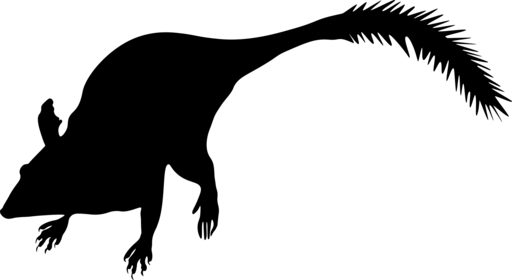
Brush-tailed Phascogale
Phascogale tapoatafa
Silhouette: Rachel T Mason · PhyloPic
- KingdomAnimalia (Animals)
- PhylumChordata (Chordates)
- ClassMammalia (Mammals)
- OrderDasyuromorphia (Carnivorous Marsupials)
- FamilyDasyuridae (Dasyurids)
- GenusPhascogale (Phascogales)
- SpeciesPhascogale tapoatafa (Brush-tailed Phascogale)
About the Brush-tailed Phascogale
The brush-tailed phascogale (Phascogale tapoatafa), also known by its Australian native name tuan, the common wambenger, the black-tailed mousesack or the black-tailed phascogale, is a rat-sized arboreal carnivorous marsupial of the family Dasyuridae, characterized by a tuft of black silky hairs on the terminal portion of its tail. Males of this species do not live past the age of one, as they die after reproducing.
The brush-tailed phascogale was first described by Friedrich Meyer in 1793; George Shaw published a revised description in 1800. For some time it was considered a member of the opossum genus Didelphis, but this ended in 1844 when Coenraad Jacob Temminck erected the genus Phascogale. The species is closely related to the red-tailed phascogale (P. calura). Its scientific name, tapoatafa, is a reference to an indigenous Australian
name for the species. It has sometimes been known as Phascogale penicillata, referring to its brushed tail. In 2015 three subspecies were identified, and the previous subspecies P. t. pirata was confirmed as a separate species P. pirata:
P. t. tapoatafa, found in southeast Australia from South Australia to mid-coastal Queensland;... Wikipedia →
Recent sightings of Brush-tailed Phascogale in Lamington National Park
LIVEiNaturalist


Global Distribution
Warmer areas are where this animal is recorded most often.
Parks Where Found
| # | Park | Country | Daily sighting probability |
|---|---|---|---|
| 1 | Lamington National Park | 🇦🇺 Australia |
More parks will be added in future updates.