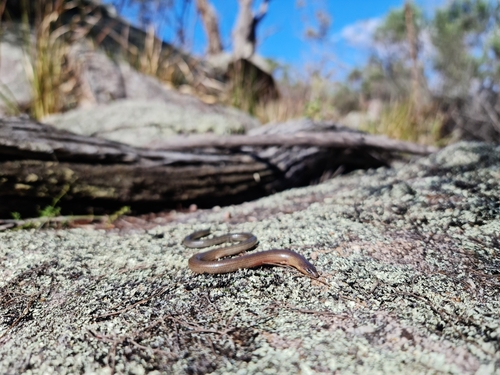

Two-clawed Worm-skink
Anomalopus leuckartii
Silhouette: Andy Wilson · PhyloPic
- KingdomAnimalia (Animals)
- PhylumChordata (Chordates)
- ClassSquamata
- FamilyScincidae (Skinks)
- GenusAnomalopus (Anomalopus Worm-Skinks)
- SpeciesAnomalopus leuckartii (Two-clawed Worm-skink)
About the Two-clawed Worm-skink
Anomalopus leuckartii, also known commonly as Leuckart's burrowing skink and the two-clawed worm-skink, is a species of lizard in the subfamily Sphenomorphinae of the family Scincidae. The species is native to eastern Australia.
The specific name, leuckartii, is in honor of German zoologist Karl Georg Friedrich Rudolf Leuckart. A. leuckartii has very small front legs. Each front leg has two toes, each of which has a claw. The rear legs are even smaller, each a mere clawless stub. Adults have a snout-to-vent length (SVL) of about 13.5 cm (5.3 in).
A. leuckhartii is found in the Australian states of New South Wales and Queensland. The preferred natural habitat of A. leuckartii is forest, but it has also been found in gardens. A. leuckartii is terrestrial and fossorial.
A. leuckartii is oviparous. Cogger HG (2014). Reptiles and Amphibians of Australia, Seventh Edition. Clayton, Victoria, Australia: CSIRO Publishing. xxx + 1,033 pp. ISBN 978-0643100350. Greer AE, Cogger HG (1985). "Systematics of the Reduce-limbed and Limbless Skinks Currently... Wikipedia →
Recent sightings of Two-clawed Worm-skink in Lamington National Park
LIVEiNaturalistClosest Relatives at Lamington National Park

 Three-clawed Worm-skink
Anomalopus verreauxii

 Land Mullet
Bellatorias major

Blue-speckled Forest Skink
Silvascincus murrayi

Eastern Water Skink
Eulamprus quoyii

Major Skink
Bellatorias frerei

 Pink-Tongued Lizard
Cyclodomorphus gerrardii

 Eastern Crevice Skink
Egernia mcpheei
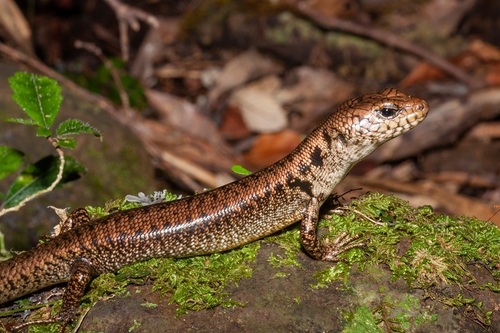
Border Ranges Blue-spectacled Skink
Silvascincus tryoni

Short-limbed Snake-skink
Ophioscincus truncatus

Three-toed Snake-tooth Skink
Coeranoscincus reticulatus

Border Ranges Shadeskink
Saproscincus challengeri

 Rainbow Skink
Lampropholis delicata
Global Distribution
Warmer areas are where this animal is recorded most often.
Parks Where Found
| # | Park | Country | Daily sighting probability |
|---|---|---|---|
| 1 | Lamington National Park | 🇦🇺 Australia |
More parks will be added in future updates.