
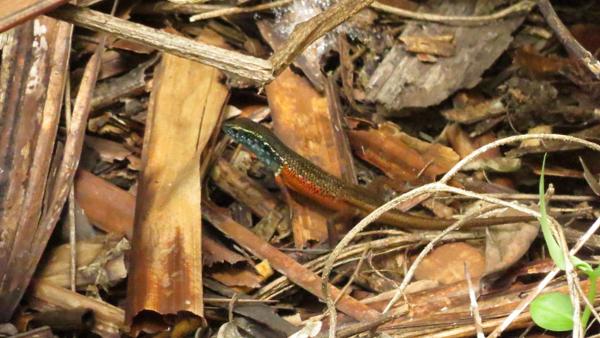
Pacific Bluetail Skink
Emoia caeruleocauda
- KingdomAnimalia (Animals)
- PhylumChordata (Cordats)
- ClassSquamata
- FamilyScincidae (Escíncid)
- GenusEmoia (Emo Skinks)
- SpeciesEmoia caeruleocauda (Pacific Bluetail Skink)
Closest Relatives at Lorentz National Park

Shrub Whiptail-skink
Emoia longicauda

Meyer's Emo Skink
Emoia kordoana

Obscure Emo Skink
Emoia obscura

Copper-tailed Skink
Emoia cyanura
Blue-grey-throated Rainbow Skink
Carlia caesius

Many-lined Sun-skink
Eutropis multifasciata

Bar-lipped Sheen-skink
Eugongylus rufescens

Prehensile Green Tree Skink
Prasinohaema prehensicauda

Emerald Skink
Lamprolepis smaragdina

Müller's Forest Skink
Sphenomorphus muelleri

Giant Blue-tongued Skink
Tiliqua gigas
📅 Monthly Probability
🌙 When They're Spotted
Most active during nighttime hours (6pm–6am) · across all parks (global)
Global Distribution
Where this species is recorded worldwide. Restricted to human observations from 2019 onwards — the same kind of record and the same period the probabilities on this page are built from, so collar-tracking studies, camera-trap arrays and museum specimens are excluded. Around Santa Rosa that removes 5,924 GPS fixes from a handful of tagged jaguars.
where this species is recorded (GBIF density — it tracks where observers go, not how likely a sighting is) · parks where it occurs — tap a pin for the sighting probability there
Parks Where Found
| # | Park | Country | Probability |
|---|---|---|---|
| 1 | Lorentz National Park | 🇮🇩 Indonesia | |
| 2 | Kinabatangan Wildlife Sanctuary | 🇲🇾 Malaysia |
Quick answers
What are the chances of seeing a Pacific Bluetail Skink in Lorentz National Park?
About 53% of visitor-days record a Pacific Bluetail Skink sighting in Lorentz National Park, based on 16 observer-days of citizen-science data from GBIF.
When is the best time to see Pacific Bluetail Skink in Lorentz National Park?
January has the highest sighting rate for Pacific Bluetail Skink in Lorentz National Park in our monthly data.