


Surinam Horned Frog
Ceratophrys cornuta
Silhouette: Margot Michaud · PhyloPic
- KingdomAnimalia (Animals)
- PhylumChordata (Chordates)
- ClassAmphibia (Amphibians)
- OrderAnura (Frogs and Toads)
- FamilyCeratophryidae (Common Horned Frogs)
- GenusCeratophrys (South American Horned Frogs)
- SpeciesCeratophrys cornuta (Surinam Horned Frog)
About the Surinam Horned Frog
The Surinam horned frog (Ceratophrys cornuta), also known as Amazonian horned frog, is a bulky frog measuring up to 20 centimetres (7.9 in) found in the northern part of South America. It has an exceptionally wide mouth, and has horn-like projections above its eyes. Females lay up to 1,000 eggs at a time, and wrap them around aquatic plants. The frog eats other frogs, fish, lizards, and mice. Tadpoles of the Surinam horned frog attack each other (and tadpoles from other species) soon after being hatched.
This species was once considered the same species as Ceratophrys ornata. This dispute was later settled because the Surinam Horned frog inhabits a different habitat than its smaller cousin and does not interbreed with it in the wild (but will do so in captivity). This species has been known to prey upon the other species of horned frog, especially the northern race of Ceratophrys ornata.
Enrique La Marca, Luis A. Coloma, Santiago Ron, Claudia Azevedo-Ramos (2004). "Ceratophrys cornuta". IUCN Red List of Threatened Species. 2004 e.T56337A11464093. doi:10.2305/IUCN.UK.2004.RLTS.T56337A11464093.en. Retrieved 12 November 2021.{{cite journal}}: CS1 maint... Wikipedia →
Recent sightings of Surinam Horned Frog in Madidi National Park
LIVEiNaturalistClosest Relatives at Madidi National Park

 Rio Mamore Robber Frog
Pristimantis fenestratus

 Spot-legged Poison Frog
Ameerega picta

 Rusty Tree Frog
Boana boans

Giant Broad-headed Treefrog
Osteocephalus taurinus

Rocket Tree Frog
Boana lanciformis
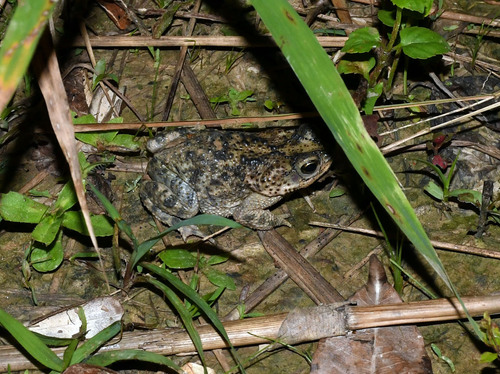
 Chaco Granulated Toad
Rhinella major

 Painted Antnest Frog
Lithodytes lineatus

 Jaguar Leaf Frog
Pithecopus palliatus

 Freiberg's Foam-Frog
Engystomops freibergi

Tiger-Striped Leaf Frog
Callimedusa tomopterna

Pearson's Spiny-backed Frog
Dryaderces pearsoni

Eastern Cane Toad
Rhinella marina
Global Distribution
Warmer areas are where this animal is recorded most often.
Parks Where Found
| # | Park | Country | Daily sighting probability |
|---|---|---|---|
| 1 | Tambopata National Reserve | 🇵🇪 Peru | |
| 2 | Brownsberg Nature Park | 🇸🇷 Suriname | |
| 3 | Manu National Park | 🇵🇪 Peru | |
| 4 | Yasuní National Park | 🇪🇨 Ecuador | |
| 5 | Madidi National Park | 🇧🇴 Bolivia | |
| 6 | Cuyabeno Wildlife Reserve | 🇪🇨 Ecuador |