


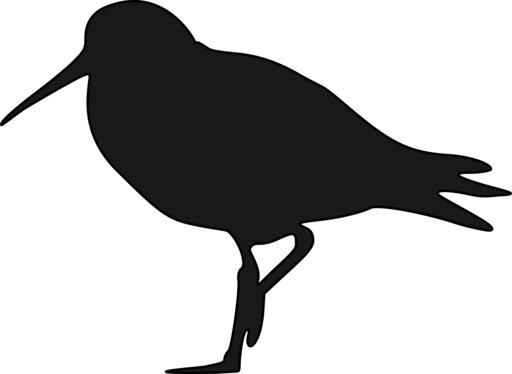
African Black Oystercatcher
Haematopus moquini
Silhouette: terngirl · PhyloPic
- KingdomAnimalia (Animals)
- PhylumChordata (Chordates)
- ClassAves (Birds)
- OrderCharadriiformes (Shorebirds and Allies)
- FamilyHaematopodidae (Oystercatchers)
- GenusHaematopus (Oystercatchers)
- SpeciesHaematopus moquini (African Black Oystercatcher)
About the African Black Oystercatcher
The African oystercatcher or African black oystercatcher (Haematopus moquini) is a large charismatic wader resident to the mainland coasts and offshore islands of southern Africa. This oystercatcher has a population of over 6,000 adults, which breed between November and April. The scientific name moquini commemorates the French naturalist Alfred Moquin-Tandon who discovered and named this species before Bonaparte.
The African oystercatcher is a large, noisy wader, with completely black plumage, red legs and a strong broad red bill. The sexes are similar in appearance, however, females are larger and have a slightly longer beak than males. Juveniles have soft grey plumage and do not express the characteristic red legs and beak until after they fledge. The call is a distinctive loud piping, very similar to Eurasian oystercatchers. As the Eurasian oystercatcher is a migratory species they only occur as a vagrant in southern Africa, and its black-and-white plumage makes confusion impossible.
Body Length: 42–45 cm (17–18 in) Wingspan: 80 and 88 cm (31 and 35 in) Mass: ♂ 665 g (1.466 lb) ♀ 730 g (1.61 lb) Tarsus: 50.6 to 60.8 mm (1.99 to 2.39... Wikipedia →
Recent sightings of African Black Oystercatcher in Namib-Naukluft National Park
LIVEiNaturalistClosest Relatives at Namib-Naukluft National Park

 Dominican Gull
Larus dominicanus

 Hartlaub's Gull
Chroicocephalus hartlaubii

 Pied Avocet
Recurvirostra avosetta

 Black-bellied Plover
Pluvialis squatarola

 Crested Tern
Thalasseus bergii

 Ruddy Turnstone
Arenaria interpres

 Curlew Sandpiper
Calidris ferruginea

 Black-winged Stilt
Himantopus himantopus

 Whimbrel
Numenius phaeopus

 Sanderling
Calidris alba

 Caspian Tern
Hydroprogne caspia

Little Stint
Calidris minuta
Global Distribution
Warmer areas are where this animal is recorded most often.
Parks Where Found
| # | Park | Country | Daily sighting probability |
|---|---|---|---|
| 1 | Garden Route National Park | 🇿🇦 South Africa | |
| 2 | Table Mountain National Park | 🇿🇦 South Africa | |
| 3 | Namib-Naukluft National Park | 🇳🇦 Namibia | |
| 4 | iSimangaliso Wetland Park | 🇿🇦 South Africa | |
| 5 | Addo Elephant National Park | 🇿🇦 South Africa | |
| 6 | Kruger National Park | 🇿🇦 South Africa |
Quick answers
What are the chances of seeing a African Black Oystercatcher in Namib-Naukluft National Park?
About 20% of wildlife watchers report a African Black Oystercatcher sighting in Namib-Naukluft National Park, based on 417 verified sightings from GBIF citizen-science data.
When is the best time to see African Black Oystercatcher in Namib-Naukluft National Park?
September has the highest sighting rate for African Black Oystercatcher in Namib-Naukluft National Park in our monthly data.