


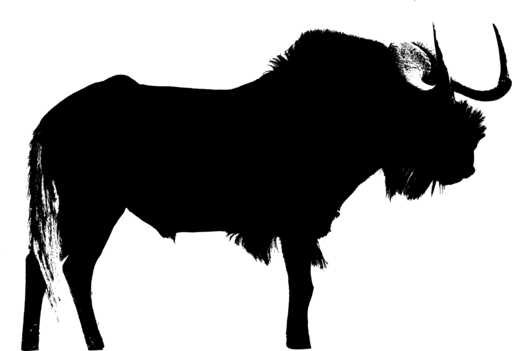
Black Wildebeest
Connochaetes gnou
Silhouette: Deon de Jager based on this photo by Bernard Dupont: http://bit.ly/3KD3Ejt · PhyloPic
- KingdomAnimalia (Animals)
- PhylumChordata (Chordates)
- ClassMammalia (Mammals)
- OrderArtiodactyla (Even-toed Ungulates and Cetaceans)
- FamilyBovidae (Bovids)
- GenusConnochaetes (Wildebeests)
- SpeciesConnochaetes gnou (Black Wildebeest)
About the Black Wildebeest
The black wildebeest or white-tailed gnu (Connochaetes gnou) is one of the two closely related wildebeest species. It is a member of the genus Connochaetes and family Bovidae. It was first described in 1780 by Eberhard August Wilhelm von Zimmermann. The black wildebeest is typically 1.7–2.2 m (5 ft 7 in – 7 ft 3 in) in head-and-body length, and the typical weight is 110–180 kg (240–400 lb). Males stand about 1.11–1.21 m (3 ft 8 in – 4 ft 0 in) at the shoulder, while the height of the females is 1.06–1.16 m (3 ft 6 in – 3 ft 10 in). The black wildebeest is characterised by its white, long, horse-like tail. It also has a dark brown to black coat and long, dark-coloured hair between its forelegs and under its belly.
The black wildebeest is an herbivore, and almost the whole diet consists of grasses. Water is an essential requirement. The three distinct social groups are the female herds, the bachelor herds, and the territorial bulls. They are fast runners and communicate using a variety of visual and vocal communications. The primary breeding season for the black wildebeest is from February to April. A single calf is usually born after a gestational period of about 8.5 months. The calf remains with its mother until her next calf is born a year later. The black wildebeest inhabits open plains, grasslands, and karoo shrublands.
The natural populations of black wildebeest, endemic in the southern part of Africa, were almost completely exterminated in the 19th century, due to their reputation as pests and the value of their hides and meat, but the species has been reintroduced widely from captive specimens, both in private areas and nature reserves throughout most of Lesotho, Eswatini, and South Africa. The species has also been introduced outside its natural range in Namibia and Kenya. Wikipedia →
Recent sightings of Black Wildebeest in Namib-Naukluft National Park
LIVEiNaturalistClosest Relatives at Namib-Naukluft National Park

 Blue Wildebeest
Connochaetes taurinus

 Gemsbok
Oryx gazella

 Springbok
Antidorcas marsupialis

Klipspringer
Oreotragus oreotragus

 Greater Kudu
Tragelaphus strepsiceros

Steenbok
Raphicerus campestris

 Khama
Alcelaphus caama

 Bush Duiker
Sylvicapra grimmia

 Common Eland
Taurotragus oryx

Impala
Aepyceros melampus

Bontebok/Blesbok
Damaliscus pygargus

 Lechwe
Kobus leche
Global Distribution
Warmer areas are where this animal is recorded most often.
Parks Where Found
| # | Park | Country | Daily sighting probability |
|---|---|---|---|
| 1 | Golden Gate Highlands National Park | 🇿🇦 South Africa | |
| 2 | Addo Elephant National Park | 🇿🇦 South Africa | |
| 3 | Namib-Naukluft National Park | 🇳🇦 Namibia |