


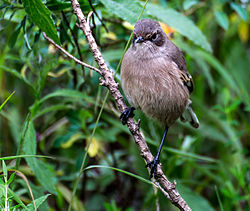
Moorland Chat
Pinarochroa sordida
Silhouette: Martin Bulla, based on François Desbordes' illustration · PhyloPic
- KingdomAnimalia (Animals)
- PhylumChordata (Chordates)
- ClassAves (Birds)
- OrderPasseriformes (Perching Birds)
- FamilyMuscicapidae (Old World Flycatchers, Robins, and Chats)
- GenusPinarochroa
- SpeciesPinarochroa sordida (Moorland Chat)
About the Moorland Chat
The moorland chat (Pinarochroa sordida), also known as the alpine chat or hill chat, is a species of songbird in the Old World flycatcher family. It is endemic to the eastern Afromontane. It lives at high altitudes on moors and grassland, usually above 3,400 m (11,100 ft), but can live as low as 2,100 m (6,900 ft). It has a short tail and long legs. It is bold and will approach people.
The moorland chat was formally described in 1837 by the German naturalist Eduard Rüppell from a specimen collected in the Simien Mountains of northern Ethiopia. Rüppell coined the binomial name Saxicola sordica. The chat was discovered on Mount Elgon on the Uganda-Kenya border by Frederick Jackson. The English geographer Halford Mackinder brought back the same bird from Mount Kenya in 1899. He presented a paper on the first ascent to the Royal Geographical Society in 1900. The scientific results of his expedition were discussed in detail afterwards.
A very curious little bird was found by Mr Jackson on Mount Elgon at a height of 11,000 feet, and I remember saying to Mr. Mackinder that he was bound to find the same sort of little chat on Mount Kenya, at a height of 11,000 feet. This... Wikipedia →
Recent sightings of Moorland Chat in Ngorongoro Conservation Area
LIVEiNaturalistClosest Relatives at Ngorongoro Conservation Area

 Capped Wheatear
Oenanthe pileata

 Northern Anteater-Chat
Myrmecocichla aethiops

White-browed Robin-Chat
Cossypha heuglini

White-eyed Slaty Flycatcher
Dioptrornis fischeri

Silverbird
Empidornis semipartitus

African Gray Flycatcher
Bradornis microrhynchus

 African Stonechat
Saxicola torquatus

Spotted Morning-Thrush
Cichladusa guttata

 African Dusky Flycatcher
Muscicapa adusta

 Northern Wheatear
Oenanthe oenanthe

Abyssinian Wheatear
Oenanthe lugubris

White-browed Scrub Robin
Erythropygia leucophrys
Global Distribution
Warmer areas are where this animal is recorded most often.
Parks Where Found
| # | Park | Country | Daily sighting probability |
|---|---|---|---|
| 1 | Bale Mountains National Park | 🇪🇹 Ethiopia | |
| 2 | Aberdare National Park | 🇰🇪 Kenya | |
| 3 | Ngorongoro Conservation Area | 🇹🇿 Tanzania | |
| 4 | Arusha National Park | 🇹🇿 Tanzania |
Quick answers
What are the chances of seeing a Moorland Chat in Ngorongoro Conservation Area?
Under 5% of wildlife watchers report a Moorland Chat sighting in Ngorongoro Conservation Area, based on 11 verified sightings from GBIF citizen-science data.
When is the best time to see Moorland Chat in Ngorongoro Conservation Area?
September has the highest sighting rate for Moorland Chat in Ngorongoro Conservation Area in our monthly data.