
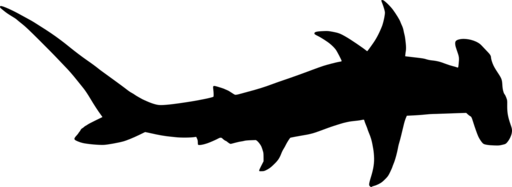
Great Hammerhead
Sphyrna mokarran
Silhouette: Andy Wilson · PhyloPic
- KingdomAnimalia (Animals)
- PhylumChordata (Chordates)
- ClassElasmobranchii
- OrderCarcharhiniformes (Ground Sharks)
- FamilySphyrnidae (Hammerhead and Winghead Sharks)
- GenusSphyrna (Hammerhead Sharks)
- SpeciesSphyrna mokarran (Great Hammerhead)
About the Great Hammerhead
The great hammerhead (Sphyrna mokarran) is the largest species of hammerhead shark, belonging to the family Sphyrnidae, attaining an average length of 4.6 m (15 ft) and reaching a maximum length of 6.2 m (20 ft). It is found around the globe in all the warmer parts of the oceans. The great hammerhead can be distinguished from other hammerheads by the shape of its "hammer" (called the "cephalofoil"), which is wide with an almost straight front margin, its tall, sickle-shaped first dorsal fin, and its strongly falcated pelvic fins. A solitary, strong-swimming apex predator, the great hammerhead feeds on a wide variety of prey ranging from crustaceans and cephalopods, to bony fish, to smaller sharks. Observations of this species in the wild suggest that the cephalofoil functions to immobilize stingrays, a favored prey. This species has a viviparous mode of reproduction, bearing litters of up to 2-49 pups every two years.
Although potentially dangerous, the great hammerhead rarely attacks humans and can sometimes behave inquisitively toward divers. This shark is heavily fished for its large fins, which are valuable on the Chinese market as the main ingredient of shark fin soup. As a result, great hammerhead populations are declining substantially worldwide, and it has been assessed as critically endangered by the International Union for Conservation of Nature (IUCN) as of 2019. Wikipedia →
Recent sightings of Great Hammerhead in Ningaloo Marine Park
LIVEiNaturalistClosest Relatives at Ningaloo Marine Park

 Scalloped Hammerhead
Sphyrna lewini

 Whitetip Reef Shark
Triaenodon obesus

 Blacktip Reef Shark
Carcharhinus melanopterus

 Sicklefin Lemon Shark
Negaprion acutidens

 Tiger Shark
Galeocerdo cuvier

Gray Reef Shark
Carcharhinus amblyrhynchos

Spinner Shark
Carcharhinus brevipinna

Dusky Shark
Carcharhinus obscurus

Australian Blacktip Shark
Carcharhinus tilstoni

Pigeye Shark
Carcharhinus amboinensis

Bronze Whaler
Carcharhinus brachyurus
Global Distribution
Warmer areas are where this animal is recorded most often.
Parks Where Found
| # | Park | Country | Daily sighting probability |
|---|---|---|---|
| 1 | Ningaloo Marine Park | 🇦🇺 Australia |
More parks will be added in future updates.